
The Role of Data Preprocessing Fitting in Peak Analysis

Data preprocessing fitting is defined as the process of learning transformation parameters exclusively from training data and applying those parameters unchanged to all subsequent datasets, including validation and test sets. This distinction is not a procedural preference. It is a mathematical requirement for valid, reproducible analytical results. In peak fitting workflows, where Gaussian, Lorentzian, and Voigt functions are resolved from overlapping signals, the role of data preprocessing fitting determines whether a model reflects true spectral structure or a statistical artifact. Tools like scikit-learn enforce this separation through the fit() and transform() interface. R2nsoftware builds the same principle into PeakLab™ at the algorithmic level.
What is data preprocessing fitting and why is it essential for peak fitting?
Data preprocessing fitting refers to the fit/transform separation principle: transformation parameters such as scaling factors, imputation values, and normalization bounds are learned exclusively on training data, then applied to test and validation sets without re-estimation. This is not a convenience pattern. The fit/transform paradigm is a mathematical correctness requirement that prevents training-to-production distribution mismatch.
In peak fitting, this principle governs every preprocessing step that precedes curve resolution. Consider a chromatographic dataset where baseline drift is corrected using a polynomial fit. If that polynomial is estimated on the full dataset including test spectra, the baseline model absorbs information from regions it should never have seen. The resulting peak integrals appear tighter and more reproducible than they actually are.
The standard steps in data preprocessing that require strict fitting discipline include:
- Data cleaning: Removing or flagging corrupted scans, saturated detector readings, and instrument artifacts before any parameter estimation
- Normalization and scaling: Computing mean, standard deviation, or min-max bounds from training spectra only, then applying those bounds to all subsequent spectra
- Imputation: Estimating missing channel values using training-set statistics, not global dataset statistics
- Encoding and feature construction: Deriving spectral indices, peak ratios, or tailing factors from training data distributions before applying them to held-out data
Improper train-test splitting causes preprocessing parameters to be contaminated by test-set information, producing unrealistic model metrics that collapse on deployment. The correct order is always: split first, then fit transformers on training data only.
Pro Tip: When working with spectral datasets in PeakLab™ or scikit-learn pipelines, define your train/test split as the very first operation in your workflow script. Every subsequent preprocessing call should reference only the training partition for parameter estimation.
How do preprocessing techniques affect peak fitting model accuracy?
The specific preprocessing operations applied before peak fitting each carry their own leakage risk and accuracy consequence. Understanding these individually is necessary for building a defensible analytical workflow.
1. Baseline correction fitting
Baseline correction in spectroscopy involves fitting a polynomial, spline, or asymmetric least-squares model to the non-peak regions of a spectrum. If this fit is computed across the full dataset, low-frequency drift characteristics from test spectra influence the correction applied to training spectra. The result is artificially reduced residuals that do not generalize.

2. Smoothing and noise filtering
Savitzky-Golay filters, Gaussian convolution, and wavelet denoising each require window parameters or bandwidth estimates. These parameters should be selected using training-set signal-to-noise statistics. Selecting them on the full dataset introduces a subtle but measurable bias toward the noise characteristics of held-out spectra.
3. Outlier detection and treatment
Outliers should never be blindly removed. In peak fitting, a data point that appears anomalous by a statistical criterion may represent a genuine spectral feature: a satellite peak, an isotope cluster, or a detector response artifact that carries physical meaning. Domain inspection is mandatory before any removal decision.
4. Feature scaling for chemometric models
When peak fitting outputs such as area, width, and asymmetry factor feed into a downstream chemometric model, those features must be scaled using training-set statistics. Fitting scalers on the full dataset before splitting inflates model accuracy by up to 40% due to data leakage. That inflation translates to complete performance collapse when the model is deployed on new spectra.
| Preprocessing step | Correct fitting scope | Consequence of incorrect scope |
|---|---|---|
| Baseline correction | Training spectra only | Artificially low residuals across all spectra |
| Feature scaling | Training-set statistics | Up to 40% inflated accuracy metrics |
| Imputation | Training-set mean or median | Test-set distribution absorbed into parameters |
| Outlier thresholds | Training-set IQR or Z-score | Test-set anomalies influence removal criteria |
Pro Tip: Use scikit-learn Pipeline objects to chain baseline correction, scaling, and peak feature extraction into a single object. The pipeline’s fit() call touches only training data, and transform() applies learned parameters to any new spectrum without re-estimation.
What pitfalls in preprocessing fitting undermine peak fitting results?
The most damaging errors in preprocessing fitting are systematic. They do not produce obvious failures. They produce results that look correct until the model is tested against independent data.
- Fitting on the full dataset before splitting. This is the single most common source of inflated performance in analytical modeling. Poor data quality and governance cost organizations an average of $12.9 million annually. A significant portion of that loss traces back to preprocessing errors that go undetected because internal metrics appear acceptable.
- Ignoring the train-test boundary in transformation steps. Researchers who apply normalization, smoothing, or baseline correction as a global preprocessing step before any split are introducing leakage at the data preparation stage, not the modeling stage. The error is invisible in cross-validation scores.
- Over-imputation of missing spectral channels. Replacing missing detector readings with dataset-wide averages rather than training-set averages introduces test-set signal into the imputed values. In mass spectrometry, where missing channels often correspond to low-abundance ions, this distorts the apparent ion distribution.
- Removing outliers without domain review. Statistical thresholds such as 3-sigma rules or interquartile range filters identify statistical extremes, not analytical errors. A chromatographic peak with an unusually high tailing factor may be a genuine sample characteristic, not a measurement error. Domain insight is required to distinguish signal from noise before any removal decision is made.
- Failing to document preprocessing parameters for production. A scaler fitted on training data must be serialized and stored alongside the model. If the scaler is re-fitted on new data at inference time, the preprocessing fitting discipline is broken even if the original workflow was correct.
More than 25% of data professionals report multimillion-dollar losses attributable to poor data quality decisions. In peak fitting research, the equivalent cost is reproducibility failure and retracted analytical conclusions.
What are the best practices for preprocessing fitting in peak fitting workflows?
A defensible preprocessing fitting workflow follows a fixed sequence. Deviating from this sequence at any step invalidates the statistical separation between training and evaluation data.
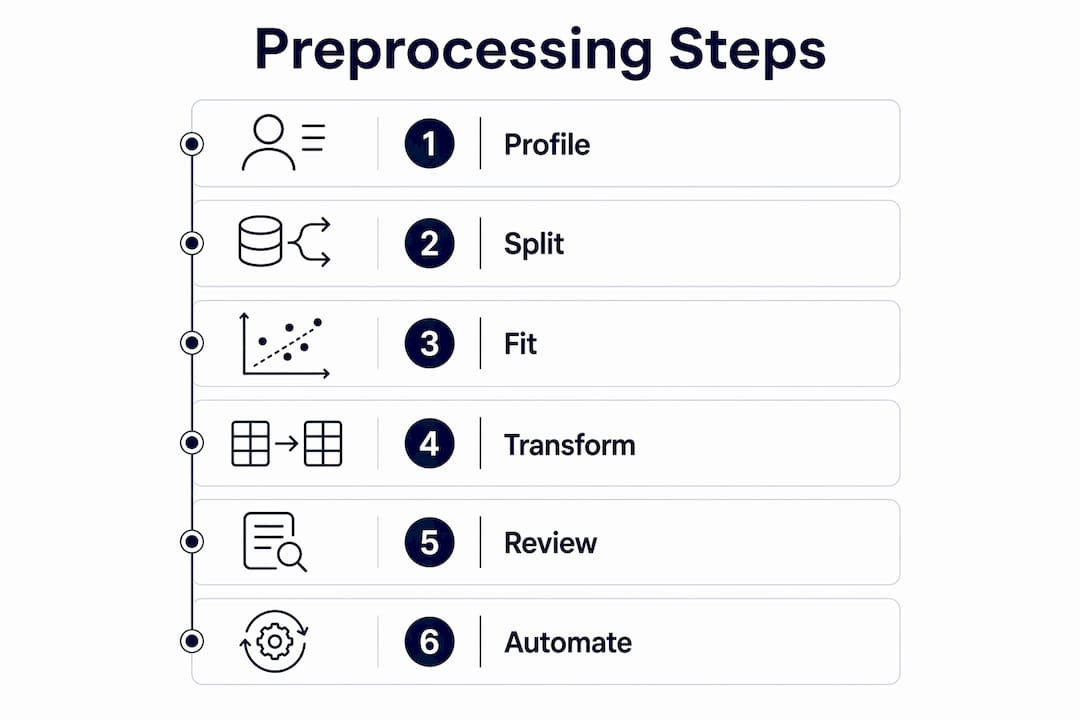
Step 1: Profile and document data origins before any transformation. Data documentation and profiling before cleaning prevents artificial biases and silent errors. For spectroscopic data, this means recording instrument model, detector type, acquisition parameters, and known artifacts before writing a single line of preprocessing code.
Step 2: Perform the train-test split as the first computational operation. No transformation, normalization, or outlier filter should touch the data before this split is complete. This is non-negotiable for valid peak fitting model evaluation.
Step 3: Fit all transformers exclusively on training data. This applies to baseline correction polynomials, scaling parameters, imputation statistics, and any feature engineering operations. The scikit-learn fit() method enforces this when used correctly within a Pipeline object.
Step 4: Apply fitted transformers to test and validation data using transform() only. The parameters learned in Step 3 are applied unchanged. No re-estimation occurs on test data.
Step 5: Conduct manual outlier review using domain knowledge. No universal preprocessing strategy exists. Domain knowledge is the deciding factor in distinguishing real spectral signals from instrument artifacts. Automated statistical filters are a starting point, not a final decision.
Step 6: Automate the full pipeline and validate reproducibility. Consistent use of pipelines eliminates leakage and improves reproducibility by enforcing the fit-on-train, transform-on-test sequence automatically. In PeakLab™, preprocessing parameters are stored with the analysis session, enabling exact replication on new datasets.
| Workflow approach | Leakage risk | Reproducibility | Deployment readiness |
|---|---|---|---|
| Manual, global preprocessing | High | Low | Poor |
| Split-first, manual transformers | Medium | Medium | Moderate |
| Pipeline-automated, split-first | None | High | Production-ready |
Pro Tip: Before publishing any peak fitting result, serialize your preprocessing pipeline and re-run the full workflow on a held-out validation set that was never used during development. If your metrics shift by more than a few percent, your preprocessing fitting discipline has a gap.
Key Takeaways
Correct preprocessing fitting, where transformation parameters are learned only from training data and applied unchanged to all other data, is the single most consequential factor in producing valid and reproducible peak fitting results.
| Point | Details |
|---|---|
| Split before preprocessing | Perform the train-test split before any transformation to prevent data leakage. |
| Fit on training data only | Learn all scaling, baseline, and imputation parameters from training spectra exclusively. |
| Domain review for outliers | Never remove spectral outliers by statistical threshold alone; manual inspection is required. |
| Pipeline automation | Use scikit-learn Pipelines or equivalent tools to enforce fit-on-train discipline automatically. |
| Document preprocessing parameters | Serialize and store all fitted transformer parameters alongside the model for production use. |
Why preprocessing fitting is the most underestimated variable in analytical research
I have reviewed enough peak fitting workflows to identify a consistent pattern: researchers invest significant effort in selecting the right peak shape function, whether Gaussian, Lorentzian, or Voigt, while treating preprocessing as a preliminary housekeeping step. That inversion of priorities is where reproducibility problems originate.
The consequences are not always visible in internal validation metrics. A workflow that fits scalers on the full dataset before splitting will produce cross-validation scores that look credible. The failure appears only when the model encounters genuinely new spectra, at which point the preprocessing parameters no longer match the data distribution. In chromatography and mass spectrometry, that mismatch translates directly to incorrect peak assignments and erroneous quantitation.
What I find most instructive is that the fix is not computationally expensive. Restructuring a workflow to split before preprocessing and wrapping transformers in a Pipeline object requires perhaps an hour of refactoring. The reproducibility gain is permanent. The risk of silent leakage is eliminated. Yet most researchers I encounter have never explicitly verified that their preprocessing steps respect the train-test boundary.
The evolving standard in data science, reflected in tools like scikit-learn and enforced by frameworks like PeakLab™, is to treat preprocessing fitting as a formal modeling step with the same rigor applied to the fitting function itself. That standard is not optional for researchers who need their results to hold up under independent replication.
— Nadeem
How R2nsoftware supports rigorous preprocessing fitting workflows
R2nsoftware builds the fit-on-train, transform-on-test principle directly into PeakLab™, its advanced peak fitting platform for spectroscopy and chromatography. PeakLab™ stores all preprocessing parameters within the analysis session, enabling exact replication on new datasets without manual re-estimation. For researchers working with overlapping signals across up to 1,000 simultaneous peaks, that level of preprocessing discipline is what separates a defensible result from a reproducible one.

R2nsoftware also offers AutoSingal for signal preprocessing and fitting workflows that require automated parameter management, and TableCurve Studio for curve fitting with integrated data preparation features. Both tools enforce correct preprocessing fitting sequences by design. Visit PeakLab™ to explore the full analytical platform and review documentation on preprocessing pipeline configuration.
FAQ
What is data preprocessing fitting in machine learning?
Data preprocessing fitting is the process of learning transformation parameters, such as scaling bounds or imputation values, exclusively from training data and applying them unchanged to test and validation sets. This separation prevents data leakage and ensures that model performance metrics reflect true generalization.
Why does fitting on the full dataset cause problems in peak fitting?
Fitting scalers or baseline correction models on the full dataset before splitting allows test-set information to influence preprocessing parameters. This inflates model accuracy by up to 40% and produces peak fitting results that do not replicate on independent spectra.
How do pipelines prevent preprocessing leakage?
Scikit-learn Pipeline objects chain preprocessing and modeling steps so that the fit() call touches only training data. The transform() method then applies learned parameters to any new data without re-estimation, eliminating leakage by construction.
Should outliers always be removed before peak fitting?
Outliers should never be removed by statistical threshold alone. In spectroscopy and chromatography, anomalous data points may represent genuine spectral features such as satellite peaks or isotope clusters. Domain expertise and manual inspection are required before any removal decision.
What is the correct order of operations for preprocessing in peak fitting?
The correct sequence is: split the dataset first, fit all transformers on training data only, apply those fitted transformers to test and validation data using transform(), and then proceed with peak fitting model training and evaluation.