Top 4 Smatrix.com Software Alternatives 2026

Managing large mass spectrometry datasets and producing reproducible, publication quality reports remains complex for analytical chemists and lab analysts. Many software packages restrict baseline modeling or lack scalable automation for high throughput processing and integrated export to core scientific formats. This comparison presents technical and workflow differentiators across four alternatives so researchers can select a package matching their throughput, reporting, and deployment requirements.
Table of Contents
PeakLab
At a Glance
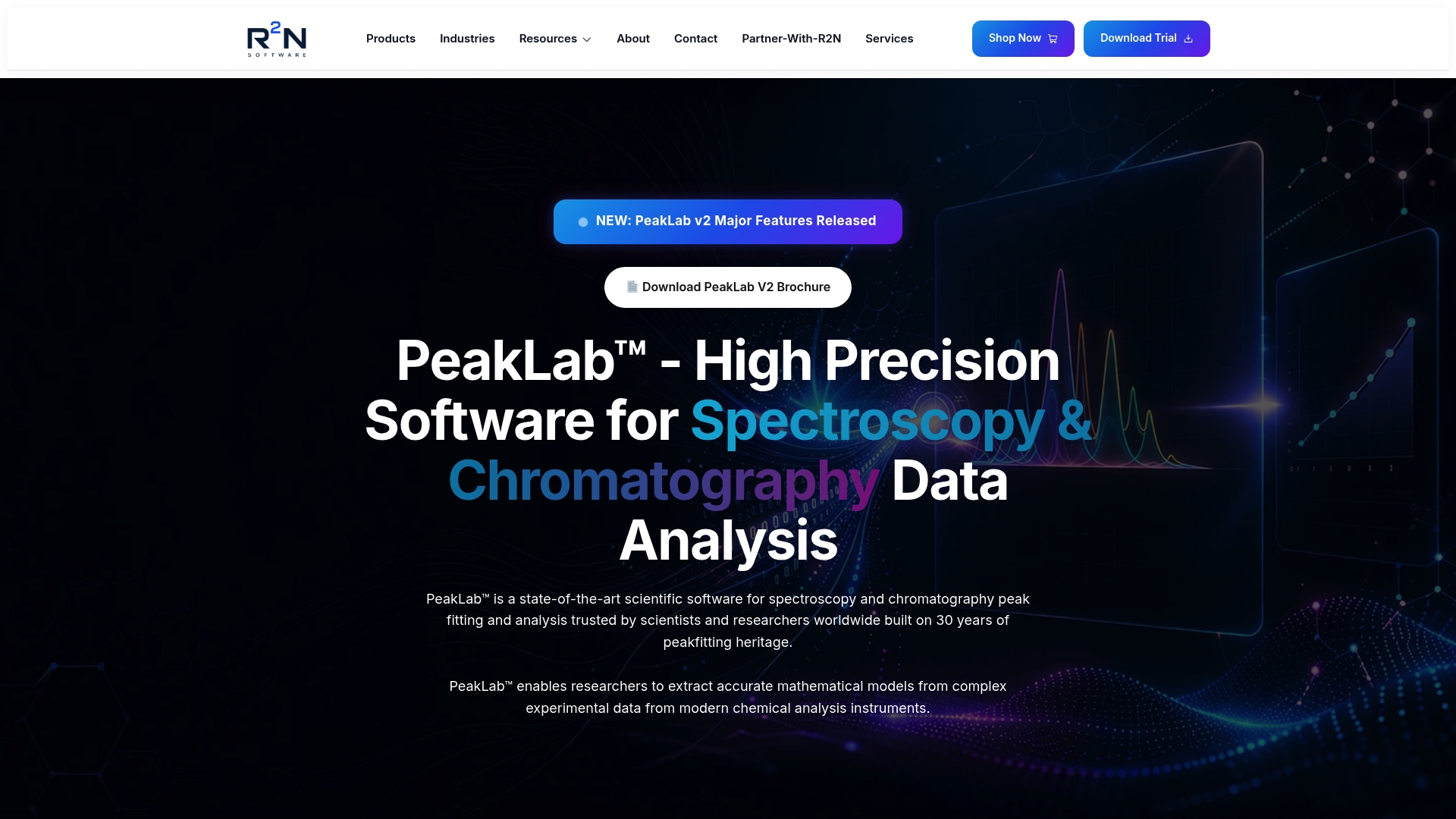
The vendor advertises support for up to 1,000 peaks simultaneously. That peak capacity helps resolve heavily overlapping signals common in chromatography and spectroscopy. PeakLab also targets mass spectrometry plus NMR, IR, Raman, Microwave, and XPS workflows.
Core Features
PeakLab delivers high precision peak fitting and convolution alongside baseline correction using Bohlmann-Whittaker, BEADS, Shirley, and Tougaard methods. It reads native instrument formats such as Agilent, OpenLab, and AIA/netCDF and handles mzML with TIC and XIC processing. The product includes MCR-ALS multivariate curve resolution, 3D spectrum analysis, automatic peak detection, parallelized optimization for large datasets, advanced nonlinear curve fitting, constrained scientific modeling, and export to CSV, Parquet, and SQL.
Key Differentiator
The vendor advertises over 30 years of scientific peak fitting heritage. PeakLab pairs that heritage with integrated, mathematically defensible peak modeling that handles complex overlapping signals and multidimensional datasets. That design focuses on producing analysis steps that can be traced, reproduced, and justified in a methods section.
Pros
PeakLab consolidates core needs for analytical chemists into one package. Its baseline modeling options and constrained nonlinear fitting reduce subjective manual adjustments during deconvolution. Native format support shortens import work for instrument outputs, and parallelized optimization keeps batch runs tractable on large experiments. Automation for high throughput processing and publication ready statistical reports cut postprocessing time for teams preparing figures and methods.
Cons
- Complex learning curve for new users unfamiliar with advanced modeling techniques and constrained optimization.
Who It’s For
Researchers and lab analysts in analytical chemistry, spectroscopy, chromatography, and mass spectrometry who require precise, reproducible curve fitting and baseline correction. Labs that run high throughput experiments or that must produce publication quality statistical reports will use its full feature set. It is less suited to occasional or casual users.
Unique Value Proposition
Publication ready statistical reports combined with direct export to CSV, Parquet, and SQL accelerate reproducible workflows. According to the company, PeakLab produces reproducible results and integrates baseline modeling into the fitting pipeline. That combination reduces manual transfer steps between analysis and reporting.
Real World Use Case
A research lab uses PeakLab to deconvolute overlapping HPLC peaks and quantify coeluting compounds. Automatic peak detection, constrained fitting, and the baseline models produce a clear methods description and exportable tables for supplemental material.
Pricing
Pricing is not specified on the website. The product appears oriented toward enterprise or professional licensing rather than single seat retail plans. Contact R2nsoftware for licensing tiers, deployment options, and a formal quote.
Website: https://r2nsoftware.com
mzmine

At a Glance
The vendor advertises high-throughput processing of thousands of samples within minutes. The vendor also states a focus on data protection and regulatory compliance. mzmine targets multimodal mass spectrometry workflows in metabolomics, lipidomics, imaging, and drug discovery.
Core Features
mzmine supports import, visualization, and processing across most vendor formats and open standards, and it supports compound annotation against spectral libraries. The software enables creation of in-house spectral libraries and molecular networking for annotation refinement. Designed for scale, it handles both small and very large datasets while keeping processing speed and data management central.
Key Differentiator
The platform distinguishes itself by combining multimodal data analysis with an emphasis on scalable deployments that meet regulatory requirements. That architecture targets laboratories that must process large sample batches and retain chain of custody for raw and processed files. The vendor positions the product for labs that require both throughput and documented data governance.
Pros
Support for a wide range of vendor formats and open standards reduces time spent on file conversion and format gaps. The vendor advertises a capacity to process thousands of samples within minutes, and that processing claim helps teams that run high-throughput screening campaigns. Flexible packaging from community to enterprise levels lets academic groups and regulated teams pick plans aligned to their audit and storage needs.
Cons
-
Community and vendor support response times can vary, which may slow issue resolution during critical experiments.
-
Primary community help is informal and volunteer based via GitHub, so guaranteed SLA support is not available for urgent incidents.
-
Broad functionality produces a steep learning curve that typically requires formal training or dedicated onboarding time.
When It May Not Fit
Organizations that need guaranteed, fast vendor support under written SLAs should look elsewhere. Small labs without training budgets may struggle with the platform’s breadth and configuration options. Teams seeking a minimal, out-of-the-box tool for a handful of samples will likely find the system more complex than necessary.
Notable Integrations
mzmine accepts most vendor formats and supports the mzML open data standard, reducing friction when combining outputs from different instruments.
Who It’s For
Research institutions, analytical laboratories, and scientific teams working in metabolomics, lipidomics, drug discovery, or environmental analysis are the primary audience. The product fits groups that manage large sample cohorts and that require traceable data handling for audits. Academic groups looking for a free community tier can evaluate core workflows before moving to paid plans.
Real World Use Case
A biotech uses mzmine PRO to process thousands of environmental samples to find candidate molecules for follow-up. The team kept complete audit trails while accelerating turnaround time for initial screening. That processing claim enabled faster lead selection and clearer handoffs to downstream validation.
Pricing
Packages range from a Community tier, which is free for educational use, through CORE, PLUS, and PRO plans, up to enterprise offers. Specific pricing and enterprise terms are provided on request by the vendor. Contact sales to match licensing and deployment to your lab’s scale and compliance needs.
Website: https://mzio.io
OpenMS
At a Glance
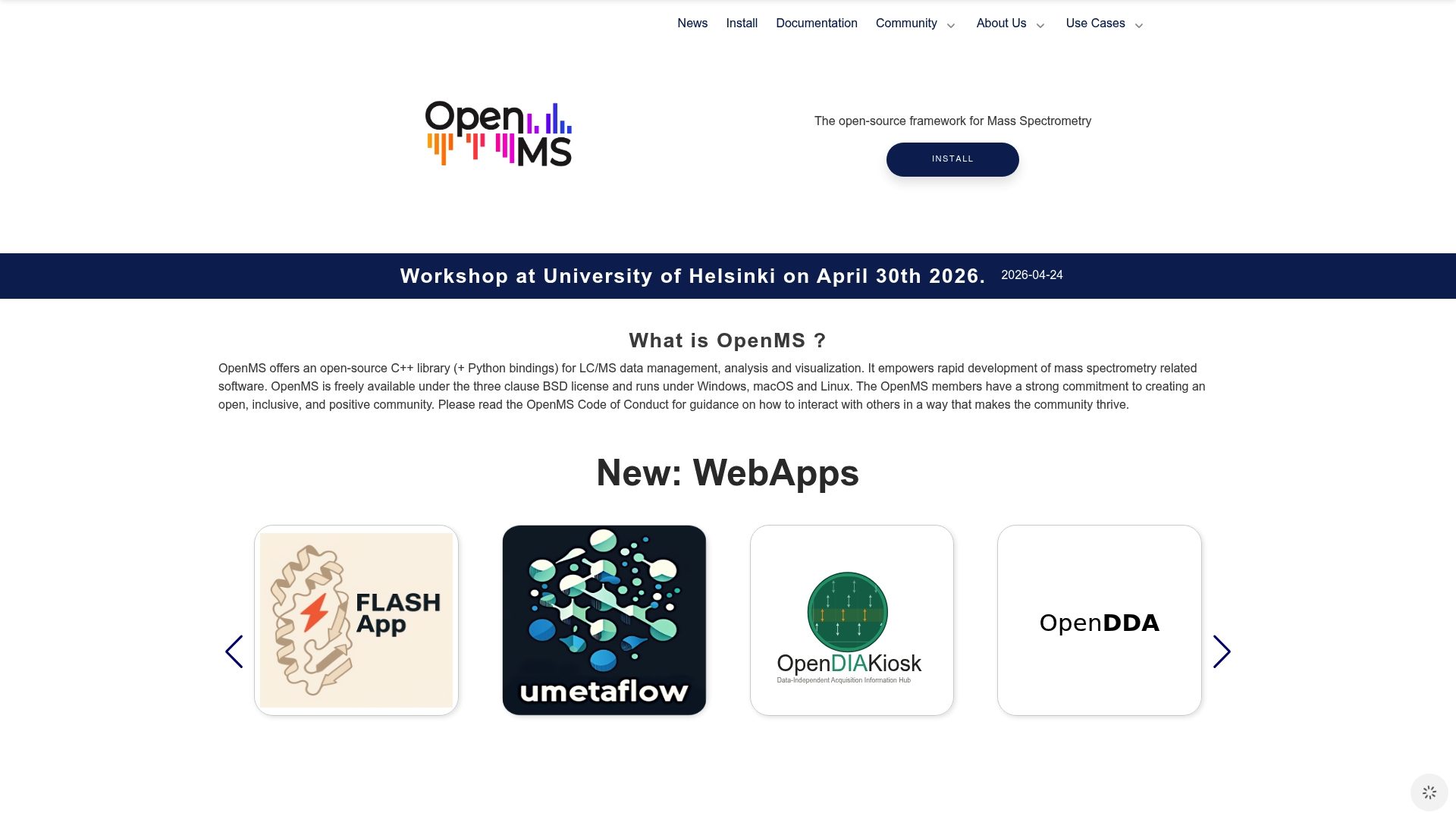
A C++ library with Python bindings manages LC/MS data and supports interactive visualization across Windows, macOS, and Linux. The framework includes web apps and workflow integration for KNIME, Galaxy, and Nextflow. It targets reproducible, scalable processing of large mass spectrometry datasets for proteomics and metabolomics.
Core Features
The codebase supplies a C++ library and Python bindings for data IO, signal processing, and visualization, with native support for mzML formats. Web apps provide interactive proteomics and metabolomics analysis, while connectors run analyses inside KNIME, Galaxy, or Nextflow workflows. Tools emphasize reproducible batch processing and scripting for high throughput studies.
Key Differentiator
The combination of native C++ performance and accessible Python bindings plus integrated web apps sets OpenMS apart. That mix lets developers implement high performance algorithms in C++ and expose them to analysts via Python and workflow platforms. The community driven model keeps development visible and extensible for laboratory pipelines.
Pros
OpenMS is open source under the BSD 3-Clause license, which removes vendor lock in and enables code inspection. Cross platform support on Windows, macOS, and Linux means the same workflow can run on laptops, servers, and compute clusters. The project delivers a wide toolset for proteomics and metabolomics and integrates into KNIME, Galaxy, and Nextflow to automate and reproduce multi-sample analyses.
Cons
-
The software has a steep learning curve for users unfamiliar with scripting or workflow engines. New users often require time to assemble pipelines.
-
Performance and usability vary by component and web app. Some tools are mature, while others feel experimental.
-
Advanced tasks frequently require command line work and custom scripts. That raises the barrier for purely GUI oriented teams.
When It May Not Fit
Teams that need a polished point and click application will find the environment demanding. Small labs without scripting expertise will face a long onboarding period. Projects that require uniform GUI quality across every analysis step may prefer a tool with commercial support and tighter UX consistency.
Who It’s For
Researchers and developers in mass spectrometry labs who write or adapt analysis code will get the most value. Bioinformaticians who build pipelines for proteomics or metabolomics can leverage the C++ core and Python bindings. Groups that require reproducible, automated processing across many samples and compute nodes will benefit from the workflow integrations.
Real World Use Case
A proteomics group used OpenMS to implement an LC MS processing chain inside KNIME, automating peak detection, alignment, and quantification for hundreds of samples. The team combined C++ modules for performance with Python wrappers for downstream statistics and reporting. The workflow produced reproducible outputs that supported publication and internal validation.
Website: https://openms.org
Ometa Labs
At a Glance
Ometa Labs reports a spectral library containing over 3 million spectra. The platform combines library search, molecular networking, and advanced query tools for small molecule discovery. It targets secure, collaborative workflows for industry and academic teams working with mass spectrometry data.
Core Features
Ometa Labs supplies platform independent analysis tools that accept data from any instrument and common file formats. The suite includes MassQL query support and molecular networking for structural similarity analysis, plus spectral library management and advanced spectrum search. Natural language queries and machine learning modules assist discovery workflows and candidate prioritization.
Key Differentiator
Ometa Labs centers on a secure, scalable collaboration environment paired with an extensive spectral library and analysis tools compatible with any MS data. That combination supports multiuser reproducibility and private database deployment for sensitive projects.
Pros
The platform reads data from any instrument, which reduces file conversion overhead and simplifies multi‑site projects. Deployment options include cloud or on premise installations, giving teams control over data residency. Collaboration features focus on reproducibility, with versioned workflows and sharing controls, and the vendor offers training and custom development for laboratory workflows.
Cons
- Requires domain knowledge: effective use demands familiarity with mass spectrometry and metabolomics workflows. This steepens the onboarding curve for generalists.
- Advanced features learning curve: complex modules such as custom ML pipelines and MassQL require time to configure and validate.
- MASST limitations: standalone MASST capabilities are limited for custom databases and very large scale searches.
When It May Not Fit
If your lab processes non‑MS data frequently, this platform is a poor match because primary support targets MS and MS/MS formats. Small teams without personnel experienced in mass spectrometry will face a steeper implementation effort. Projects that need lightweight, consumer style interfaces may find the platform more technical than necessary.
Who It’s For
Researchers in pharmaceutical discovery, environmental monitoring, and academic metabolomics will gain most from Ometa Labs. Teams that require secure collaboration and private spectral databases will find the deployment options useful. Groups ready to invest in training and workflow validation will extract the highest value.
Real World Use Case
A pharmaceutical group used Ometa Flow to process global MS datasets, identify known metabolites, and flag novel candidates for structural follow up. Analysts shared annotated networks across sites and exported validated spectral references to a private library for regulatory filings.
Pricing
According to the company, pricing starts as low as $10K for an enterprise license. That starting figure includes options for small team licenses and academic discounts, with custom quotes for on premise deployments.
Website: https://ometalabs.net
Comparison of alternatives
When evaluating alternatives for mass spectrometry analysis tools, key functionalities such as peak fitting precision, scalability, and reproducibility become considerations.
Analysis through workflow versatility
Each tool offers distinct advantages catering to various analysis workflows. PeakLab stands out for its advanced peak resolution, leveraging constrained nonlinear fitting to refine overlapping signal deconvolutions. On the other hand, OpenMS provides an open-source solution targeting flexible integration of customizable algorithms, ideal for proteomics and metabolomics research environments.
Cost-efficiency in different user scenarios
Tools like mzmine excel in supporting large-scale testing by enabling processes for thousands of samples within brief periods, which is key for labs conducting high-throughput experiments. Meanwhile, Ometa Labs scores high in secure collaborative applications with its extensive private spectral library offerings, tailored for pharmaceutical and interdisciplinary academic research.
Best fit
-
Research and laboratory institutions needing highly analytical deconvolution capabilities coupled with reproducibility and transparent methods should opt for PeakLab.
-
Large environmental research labs processing extensive datasets would benefit from mzmine’s scalability support.
-
Software development-intensive groups could find OpenMS’ emphasis on custom C++ and Python flexibility a strong feature.
-
Pharmaceutical entities conducting shared exploratory investigations will gain utility from Ometa Labs’ spectrum library archival methods.
Our pick
While each platform presents compelling features for specific scenarios, r2nsoftware.com offers a well-rounded balance of precision peak fitting, baseline corrections, and effective workflow integration. Laboratories with a focus on producing reproducible datasets and transparent analysis methods while expediting postproduction steps will find it their definitive choice.
Identifying the most suitable solution for spectroscopy analysis entails weighing the products’ unique features and strengths.
| Product | Primary Use Case | Key Differentiator | Pricing | Notable Limitation |
|---|---|---|---|---|
| R2nsoftware | Advanced signal deconvolution in various spectroscopies | Over three decades of expertise that ensures reproducibility | Price not published | Learning curve for complex modeling techniques |
| mzmine | High-throughput mass spectrometry for metabolomics and drug discovery | Scalable deployments emphasizing data protection | Free to enterprise tiers | Variable community and vendor support response |
| OpenMS | Automated processing and analysis in mass spectrometry | C++ library with Python bindings for custom solutions | Open source under BSD | Advanced tasks require command line expertise |
| Ometa Labs | Spectral database management and molecular networking | Extensive library of 3M+ spectra with collaborative tools | Starting at $10K | Complex modules take time for effective usage |
How to Address Challenges in Peak Fitting and High Throughput Data Analysis
Analytical chemistry teams researching mass spectrometry and spectroscopy frequently encounter the challenge of accurately fitting and separating up to 1,000 overlapping peaks simultaneously. This task demands mathematically rigorous baseline correction and reproducible curve fitting methods that reduce manual adjustments and produce publication-ready statistical reports. R2nsoftware’s PeakLab™ offers a solution tailored for researchers and lab analysts who handle complex chromatography and spectroscopy datasets.
PeakLab™ employs advanced algorithms and supports native instrument formats, streamlining data import and enabling high throughput processing. Its integration of mathematically defensible peak modeling and baseline correction reduces error and accelerates method validation workflows for analytical chemistry projects. Learn more about how PeakLab™ can improve peak deconvolution precision and batch experiment throughput by visiting R2nsoftware.
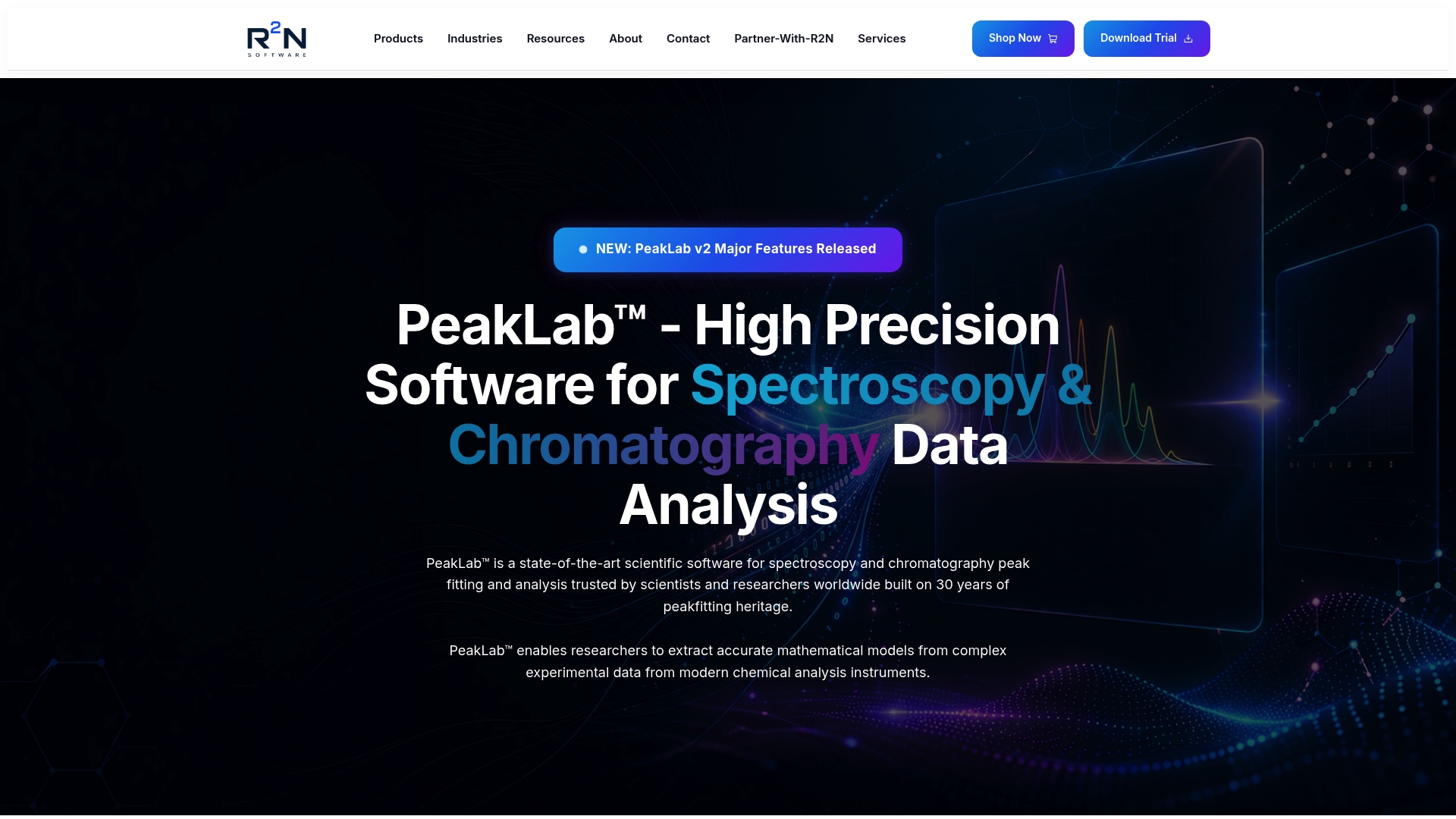
Validate your peak analysis with software designed for complex multi-peak fitting and reproducible results. Explore PeakLab™ at https://r2nsoftware.com and access a platform built for professional data analysis in chromatography and spectroscopy.
FAQ
Which platform supports high throughput processing for thousands of samples within minutes?
R2nsoftware excels in high-throughput processing capabilities, making it suitable for labs that require rapid analysis of multiple samples. It efficiently handles mass spectrometry data, delivering quick results and saving valuable time for researchers. Users should consider this factor when selecting software for extensive datasets.
What is the difference between R2nsoftware and mzmine in terms of support for data formats?
mzmine offers extensive support for a wide range of vendor formats and open standards, which reduces the time spent on file conversion. R2nsoftware, while focusing on core features, also provides native format support for instruments like Agilent and OpenLab but may not match mzmine’s depth in format flexibility. Researchers should analyze their specific data needs before deciding.
Can I rely on R2nsoftware for producing publication-ready statistical reports?
R2nsoftware generates publication-ready statistical reports integrated with its data analysis features. This functionality simplifies the reporting process significantly and allows teams to proceed confidently with their findings. It’s a solid choice for those aiming to prepare their results for publication.
What should I consider regarding the complexity of R2nsoftware’s learning curve?
R2nsoftware features a complex learning curve, especially for users unfamiliar with advanced modeling techniques. This aspect may require additional training and time investment before full adoption. Potential users should evaluate the available support resources when planning development or training timelines.
How does R2nsoftware handle overlapping signals in mass spectrometry?
R2nsoftware specifically targets complex overlapping signals with advanced peak modeling and fitting capabilities. This feature is crucial for accurate analysis and assists researchers in obtaining reliable results from complicated datasets. Users looking for precision in their data analysis should note this strength.