
Identifying Co-Eluting Compounds in Mass Spectrometry

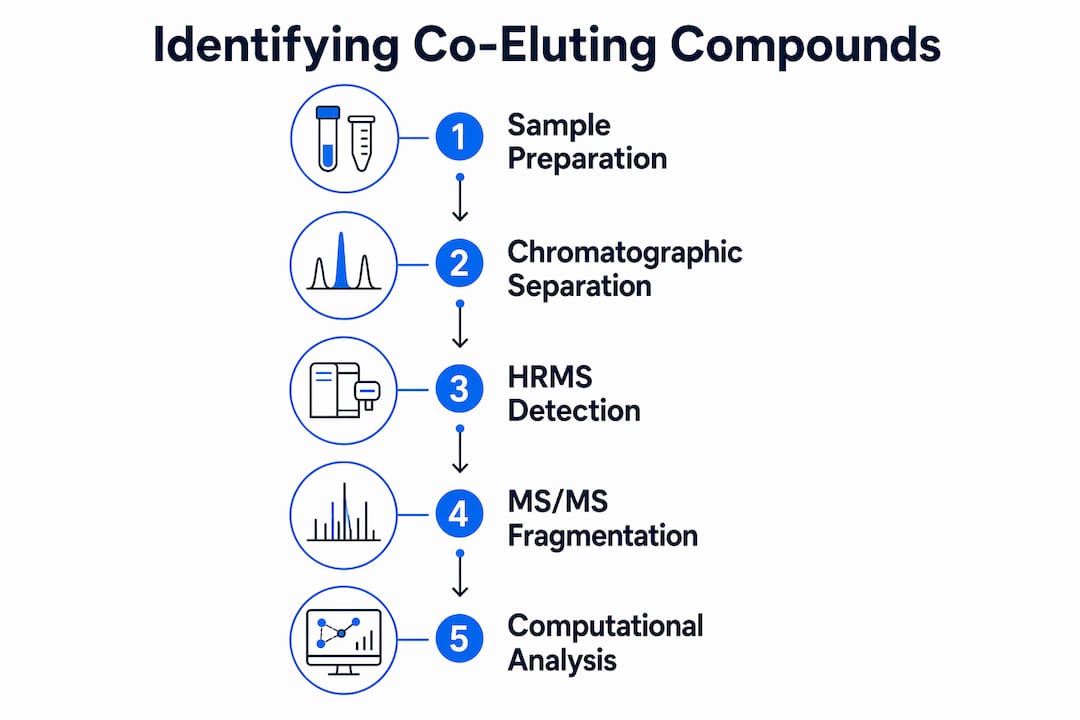
Co-eluting compounds in mass spectrometry are defined as two or more chemical species that exit a chromatographic column within the same retention time window, producing overlapping signals that complicate accurate identification. Identifying co-eluting compounds in mass spectrometry requires a tiered strategy combining optimized chromatographic separation, high-resolution accurate-mass spectrometry (HRMS), and chemometric data analysis. No single technique resolves every case. Researchers working in pesticide residue analysis, pharmaceutical impurity profiling, and metabolomics routinely encounter this problem, and the consequences of misidentification range from failed regulatory submissions to flawed clinical conclusions.
What are co-eluting compounds and why are they challenging to identify in mass spectrometry?
Co-elution occurs when two or more compounds share nearly identical retention times on a chromatographic column, causing their mass spectral signals to overlap in the detector. The result is a composite spectrum that neither compound fully owns. Spectral interpretation becomes unreliable because fragment ions, isotope patterns, and precursor masses from multiple species merge into a single apparent peak.
The most problematic cases involve isobaric compounds. These are molecules with the same nominal mass but different molecular formulas or structural arrangements. A well-documented example is ketoprofen and fenbufen, which share the same molecular formula and require retention time differentiation for confident identification. Methiocarb and ethiofencarb present the same challenge. Even with high-resolution instruments, isobaric pairs at similar concentrations can produce nearly indistinguishable spectral profiles.
The core challenges in co-eluting compound detection include:
- Spectral mixing: Fragment ions from two compounds appear in one MS/MS spectrum, making library matching unreliable.
- Signal suppression: A dominant compound at high concentration can suppress ionization of a low-abundance co-elutant, masking its presence entirely.
- Chromatographic peak overlap: Broad or tailing peaks increase the probability that two species share a retention time window.
- Isobaric interference: Compounds with mass differences below the instrument’s resolving power appear as a single peak in the mass spectrum.
- False negatives in TIC: The Total Ion Chromatogram integrates all ions, which can obscure minor co-eluting species beneath a dominant signal.
Understanding these failure modes is the foundation for selecting the right combination of separation and detection strategies.
How does chromatographic separation optimization reduce co-elution issues?
Chromatographic separation is the first and most cost-effective defense against co-elution. Improving resolution at the column level reduces the burden placed on the mass spectrometer to differentiate compounds computationally. The standard criterion for compound identity confirmation combines a retention time window defined as tR ± 3 standard deviations with accurate mass at 5 ppm tolerance. This dual criterion filters out false positives that mass accuracy alone cannot exclude.
Key chromatographic strategies for reducing co-elution include:
- Column chemistry selection: Reversed-phase C18 columns remain the standard for most small-molecule analyses, but phenyl-hexyl and mixed-mode columns provide orthogonal selectivity for structurally similar compounds.
- Mobile phase optimization: Adjusting organic modifier gradients, pH, and ion-pairing reagents shifts retention times of closely eluting species.
- UHPLC and UPLC technology: Ultra-high-performance liquid chromatography systems operating at elevated pressures deliver sharper peaks and shorter run times, reducing the probability of peak overlap.
- Temperature control: Column temperature affects selectivity. Small changes of 5–10°C can shift the elution order of structurally similar compounds.
- Method validation: Confirming resolution across a range of matrix types and analyte concentrations prevents co-elution from appearing only in real samples.
Pro Tip: When developing a method for complex matrices such as food extracts or biological fluids, run a blank matrix extract alongside your standard to identify any endogenous compounds that co-elute with your target analytes before finalizing gradient conditions.
Chromatographic method development is not a one-time task. Column aging, mobile phase batch variability, and matrix effects all shift retention times over time. Regular system suitability checks using a reference compound mixture protect against gradual drift that reintroduces co-elution into a previously validated method.
What role does high-resolution accurate-mass spectrometry (HRMS) play in distinguishing co-eluting compounds?
HRMS is the primary instrumental strategy for differentiating co-eluting compounds that chromatography cannot fully resolve. The resolving power required depends directly on the mass difference between the target compounds. Resolutions of at least 40,000 are required to separate isobaric pesticides with close molecular ions, and resolution up to 100,000 improves accuracy in complex matrices. At m/z 292.02656 and 292.04031, baseline separation requires instruments operating above 40,000 resolving power. That mass difference of approximately 0.014 Da is invisible to low-resolution instruments.

The table below compares key HRMS parameters relevant to co-eluting compound resolution:
| Parameter | Typical Range | Impact on Co-elution Resolution |
|---|---|---|
| Resolving power | 40,000–100,000 | Separates isobaric species with small mass differences |
| Mass accuracy | ≤5 ppm | Confirms molecular formula and filters false positives |
| Scan speed | 5–20 Hz | Maintains peak shape integrity across narrow UHPLC peaks |
| Dynamic range | 10^4–10^6 | Detects low-abundance co-elutants beside dominant species |
HRMS alone does not solve every co-elution problem. High resolution MS up to 100,000 improves mass accuracy but cannot fully replace chromatographic separation, especially for isobaric compounds at low concentrations. When two compounds share the same molecular formula, no amount of resolving power separates them by mass. That is where MS/MS fragmentation becomes decisive.
MS/MS fragmentation spectra enhance structural identification beyond accurate mass, improving confidence in differentiating co-eluting compounds. Combining full-scan accurate mass with targeted MS/MS spectra improves specificity in complex mixtures. A compound that produces identical precursor masses to a co-elutant will generate a distinct fragmentation pattern if its connectivity differs. This is the structural fingerprint that confirms identity when mass alone is ambiguous.
Pro Tip: Use data-independent acquisition (DIA) modes such as SWATH or all-ion fragmentation when screening complex samples. These modes collect MS/MS data across all precursor masses simultaneously, preserving fragmentation information for co-eluting species that targeted MS/MS would miss.
Which data analysis and software strategies improve identification of co-eluting compounds?
Computational workflows are the third pillar of co-eluting compound detection. Raw data processing, not peak list extraction, is the correct starting point. Effective use of software requires processing raw vendor file formats to retain isotopic and abundance information critical for distinguishing co-eluting isobaric species. Converting raw data to peak lists before processing discards the isotope envelope and abundance ratios that differentiate isobaric compounds.
The choice between TIC and EIC is not trivial. TIC alone can mask low-concentration co-eluting impurities. EIC improves detection of subtle species in overlapping peaks by filtering the chromatogram to a specific mass-to-charge ratio window. This approach reveals compounds hidden beneath a dominant TIC signal.
Key software tools and strategies for co-elution analysis include:
- Extracted Ion Chromatograms (EIC): Filter by exact mass to isolate individual compound signals from a composite chromatographic peak.
- Automated peak tracking: Molecular weights detected by MS and EIC similarity scoring differentiate co-eluted compounds by retention time shifts across sample sets.
- In silico annotation tools: MetFrag, MS-FINDER, and SIRIUS each apply different scoring algorithms to match experimental spectra against structural databases. Using all three and comparing outputs reduces false positive annotations.
- Chemometric deconvolution: Multivariate curve resolution (MCR) and PARAFAC decomposition separate overlapping spectral contributions mathematically when chromatographic resolution is insufficient.
- Impurity profiling workflows: Full-scan MS detects co-eluting impurities down to 0.5% concentration not seen by UV detectors. The Microsaic 4000 MiD demonstrated this capability in pharmaceutical purity assessment.
The confidence gap in automated annotation is significant. Only 2–13% of mass spectra are confidently assigned by automated software. That figure means automated tools produce uncertain or incorrect annotations for the vast majority of spectra in complex mixtures. Expert review with chemical constraints applied to the annotation workflow is not optional. It is the difference between a defensible result and a misleading one.
What best practices and troubleshooting steps help avoid common pitfalls?
Troubleshooting mass spectrometry co-elution starts with systematic verification rather than software trust. The following numbered workflow applies to both method development and post-acquisition data review.
- Verify retention time consistency. Confirm that the retention time of your target compound matches the reference standard within the tR ± 3 SD window across all injections. Drift outside this window signals a co-elution or column degradation problem.
- Switch from TIC to EIC immediately. Any time a peak appears broader than expected or shows an asymmetric shape, extract the ion chromatogram at the exact mass of your target. A shoulder or split peak in the EIC confirms a co-eluting species.
- Check the isotope ratio. The measured isotope pattern of a peak should match the theoretical pattern for the molecular formula. A distorted ratio indicates a co-eluting compound contributing ions to the same nominal mass window.
- Acquire MS/MS at multiple collision energies. A single collision energy may not generate all diagnostic fragment ions. Running stepped or ramped collision energies captures the full fragmentation profile needed for structural confirmation.
- Apply chemical constraints in annotation software. MetFrag, SIRIUS, and MS-FINDER all accept chemical constraints such as element restrictions and adduct rules. Applying these constraints before running annotation reduces the false positive rate substantially.
Pro Tip: When a co-eluting compound is suspected but not confirmed, inject the sample at two different pH values or on a column with different stationary phase chemistry. If the suspect peak shifts relative to your target, you have confirmed co-elution and can proceed with separation optimization.
A tiered approach combining optimized chromatography, HRMS detection, and MS/MS fragmentation is the established best practice. Relying on any single technique introduces systematic blind spots. Gas-phase ion chemistry in electrodynamic traps represents an emerging orthogonal strategy. Ion-ion and ion-molecule reactions differentiate co-eluting species based on gas-phase reactivity rather than mass, providing information that standard MS cannot generate. This approach is not yet routine but is gaining traction in research environments where isobaric resolution by mass alone is insufficient.
Key Takeaways
Confident identification of co-eluting compounds in mass spectrometry requires chromatographic optimization, HRMS resolving power above 40,000, MS/MS structural confirmation, and expert-validated data analysis workflows applied in combination.
| Point | Details |
|---|---|
| Chromatographic separation first | Define retention time windows as tR ± 3 SD and optimize column chemistry before relying on MS resolution. |
| HRMS resolving power matters | Resolving power of 40,000–100,000 is required to separate isobaric compounds with small mass differences. |
| EIC over TIC | Use Extracted Ion Chromatograms to detect low-abundance co-elutants masked by dominant TIC signals. |
| MS/MS confirms structure | Fragmentation spectra differentiate compounds with identical precursor masses when accurate mass alone is insufficient. |
| Automated annotation needs expert review | Only 2–13% of mass spectra are confidently assigned automatically; chemical constraints and expert validation are required. |
Where I’ve seen researchers go wrong with co-elution analysis
Most co-elution failures I have observed do not come from instrument limitations. They come from workflow design decisions made before the sample ever reaches the MS inlet. Researchers invest in high-resolution instruments and then process data as peak lists, discarding the isotope envelope information that would have resolved the ambiguity. The instrument did its job. The data pipeline undid it.
The second recurring mistake is treating HRMS as a complete solution. High resolving power is necessary but not sufficient. Isobaric compounds with identical molecular formulas cannot be separated by mass, regardless of the instrument’s resolving power. When I see a method that relies exclusively on accurate mass without a retention time criterion or MS/MS confirmation, I expect false positives in complex matrices. The tR ± 3 SD window combined with 5 ppm mass accuracy is not a bureaucratic requirement. It is the minimum defensible standard.
The third issue is annotation software used without chemical constraints. MetFrag, SIRIUS, and MS-FINDER are genuinely useful tools. They are not autonomous identification systems. The 2–13% confident assignment rate is a sobering number. It means that for most spectra in a complex mixture, the software is guessing within a constrained space. Expert review with domain knowledge applied to the chemical constraints is what converts a candidate list into a confirmed identification.
My recommendation is to treat co-elution analysis as a three-stage process: separate as much as possible chromatographically, detect and differentiate by HRMS and MS/MS, then validate computationally with constraints. Skipping any stage increases the error rate in ways that are difficult to detect retrospectively.
— Nadeem
How R2nsoftware supports co-elution analysis in mass spectrometry
Researchers dealing with overlapping chromatographic signals need software that operates at the level of the raw data, not the processed peak list. R2nsoftware’s PeakLab applies advanced mathematical algorithms and statistical models to resolve overlapping signals, supporting up to 1,000 peaks simultaneously. That capacity is directly relevant to complex mixture analysis where co-eluting species produce composite peak profiles that standard integration software cannot deconvolute.

PeakLab’s baseline modeling and curve fitting capabilities address the signal smearing and tailing effects that amplify co-elution errors in chromatographic data. For researchers who want to see these workflows in practice, R2nsoftware’s tutorial video library demonstrates peak deconvolution and signal analysis across chromatography and spectroscopy applications. The AutoSingal tool extends these capabilities to automated peak detection and purity assessment, reducing manual review time without sacrificing the expert validation that complex co-elution cases require.
FAQ
What are co-eluting compounds in mass spectrometry?
Co-eluting compounds are two or more chemical species that exit a chromatographic column at the same retention time, producing overlapping mass spectral signals. Their composite spectra complicate accurate identification and quantification.
How do I identify co-eluting compounds in my MS data?
Switch from Total Ion Chromatogram to Extracted Ion Chromatogram at the exact mass of your target compound. A shoulder, split peak, or distorted isotope ratio in the EIC confirms a co-eluting species.
What resolving power does HRMS need to separate isobaric compounds?
Resolving power of at least 40,000 is required to baseline-separate isobaric pesticides with close molecular ions; resolution up to 100,000 improves performance in complex matrices.
Can automated annotation software reliably identify co-eluting compounds?
Automated software confidently assigns only 2–13% of mass spectra. Expert review with chemical constraints applied in tools like MetFrag, SIRIUS, or MS-FINDER is required for defensible identification.
When should I use MS/MS fragmentation for co-elution confirmation?
Use MS/MS whenever two compounds share the same molecular formula or when accurate mass alone cannot distinguish between candidates. Fragmentation spectra provide structural fingerprints that precursor mass cannot.