
Best Methods for Spectral Denoising in Practice
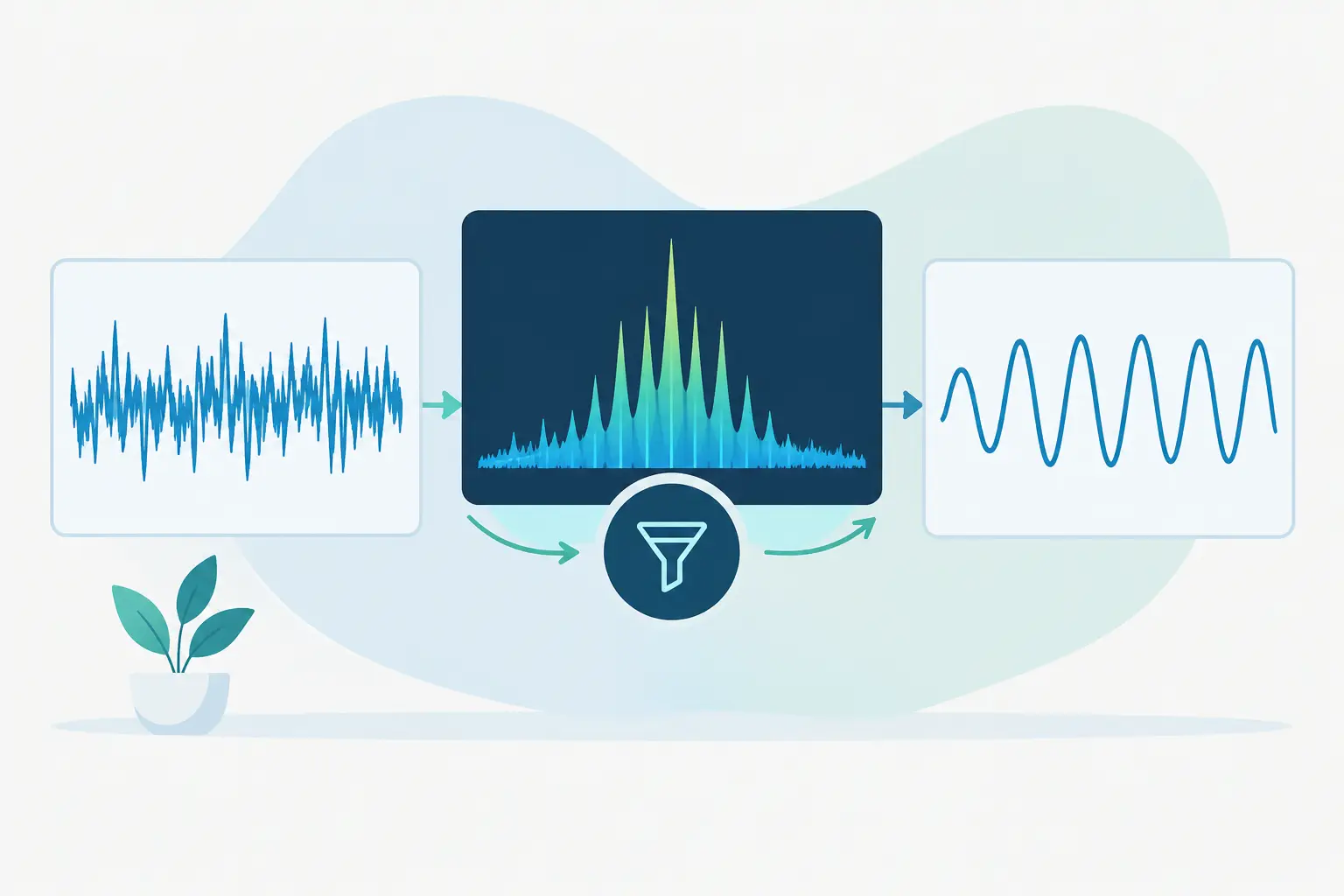
A spectrum can look cleaner after filtering and still be less scientifically useful. A narrow Raman band may be broadened, a weak IR shoulder may disappear, or high-frequency structure that distinguishes two chemical states may be treated as noise. The best methods for spectral denoising are therefore not the methods that produce the smoothest trace. They are the methods that reduce random variation while preserving the peak positions, widths, areas, asymmetry, and uncertainty needed for defensible interpretation.
For spectroscopy, denoising must be selected in the context of the measurement, the expected signal structure, and the downstream model. A preprocessing choice that is acceptable for qualitative classification can be unacceptable before quantitative peak fitting, deconvolution, or publication-level parameter estimation. The central question is not, “Which filter looks best?” It is, “Which treatment removes noise without changing the analytical conclusion?”
What Spectral Denoising Must Preserve
Spectral noise is not a single phenomenon. Detector noise, shot noise, digitization effects, fluorescence, interference fringes, cosmic-ray spikes, and baseline drift have different origins and require different responses. Treating all unwanted variation with one aggressive smoothing operation is a common source of biased results.
A valid denoising procedure should preserve local maxima and minima, maintain integrated peak area where quantitation depends on area, and avoid systematic shifts in peak center or full width at half maximum. It should also leave residuals that behave like unstructured measurement noise rather than patterned signal. If a filter produces visually attractive curves but introduces correlated residuals or changes fitted component ratios, it has altered the measurement rather than clarified it.
Baseline correction and denoising must also be separated conceptually. Baseline drift is typically a low-frequency component arising from fluorescence, scattering, detector behavior, or instrumental conditions. Random noise is stochastic variation around the underlying spectral signal. Removing a baseline with a smoothing filter can flatten broad bands or distort weak features. Likewise, fitting a baseline to a noisy trace without appropriate noise treatment can cause the baseline model to absorb genuine signal.
Best Methods for Spectral Denoising by Data Behavior
No universal filter is best across UV-Vis, Raman, IR, NMR, XPS, and mass-spectrometry-derived profiles. The appropriate method depends on peak width, sampling density, noise frequency content, and whether the final objective is identification, calibration, or quantitative component resolution.
Savitzky-Golay smoothing for well-sampled peaks
Savitzky-Golay filtering fits a low-order polynomial within a moving window and evaluates the fitted signal at the window center. Unlike a simple moving average, it can preserve the height, width, and shape of reasonably sampled peaks when the window is selected correctly. This makes it a useful first-line option for spectra containing smooth, resolved bands with approximately uniform spacing.
Its limitation is parameter sensitivity. A window that is too short provides little noise reduction; a window that is too long rounds narrow peaks, suppresses shoulders, and can shift extrema. Polynomial order also matters. Higher orders can follow local curvature but may reproduce noise or create edge artifacts. The window should be substantially narrower than the narrowest feature that must be retained, then verified against known standards or replicate spectra. Savitzky-Golay processing is particularly appropriate when derivative spectroscopy is needed, since the method can calculate smoothed derivatives directly, but derivative results demand even stricter parameter control.
Wavelet denoising for mixed-scale spectral structure
Wavelet denoising decomposes a spectrum into components at multiple scales. Noise commonly appears in high-frequency coefficients, while chemically meaningful bands span one or more larger scales. Thresholding selected coefficients can reduce noise while retaining sharp and broad features better than a single fixed-window smoother.
This flexibility is valuable for Raman spectra with narrow lines superimposed on broader structure, or for IR and XPS data where meaningful information exists across different peak widths. Yet wavelet choices are not neutral. The wavelet family, decomposition level, thresholding rule, and threshold value can each affect reconstructed line shape. Hard thresholding may introduce discontinuities; soft thresholding can attenuate small peaks. Wavelet denoising should be assessed with reconstruction error, retained peak metrics, and residual structure, not simply by visual smoothness.
Fourier-domain filtering for known periodic noise
Fourier filtering is effective when the unwanted component occupies a clearly identifiable frequency range, such as periodic electronic interference or fringes with a stable frequency. In such cases, targeted notch or band-stop filtering can remove a specific contaminant with minimal impact on the rest of the signal.
It is less appropriate for general-purpose denoising. Sharp frequency cutoffs can cause ringing in the reconstructed spectrum, and genuine narrow peaks inherently contain high-frequency information. Before applying a Fourier filter, inspect whether the apparent frequency component is genuinely instrumental and stable across replicate measurements. If it overlaps the spectral content of interest, filtering can erase valid analytical structure.
Median and spike filters for impulsive artifacts
Isolated cosmic-ray events and detector spikes are not well handled by conventional smoothing. They are impulsive outliers, often many times larger than nearby intensity values. Median filters or local outlier-detection rules can identify and replace these points using neighboring observations, generally with far less effect on normal peak shape than broad smoothing.
The replacement rule must be conservative. A real narrow emission feature, poorly sampled peak, or abrupt spectral transition can resemble a spike if judged only by local amplitude. Replicate acquisition, detector knowledge, and examination of raw data are the best safeguards. Remove confirmed artifacts first, then apply any broader denoising method if needed.
PCA and multivariate denoising for replicate-rich datasets
When spectra are collected across samples, time points, pixels, or process batches, multivariate methods can separate systematic signal from uncorrelated noise. Principal component analysis, for example, represents the dataset with a limited number of orthogonal components. Reconstructing spectra from retained components can reduce random variation while preserving covariance patterns that recur across observations.
This approach is powerful for hyperspectral imaging, process monitoring, and large spectral libraries. It is not automatically safe for rare but meaningful features. A low-abundance impurity, transient intermediate, or localized spatial component may be relegated to a low-variance principal component and discarded. Component retention should be driven by cross-validation, replicate consistency, known chemistry, and the needs of the analytical decision, not an arbitrary explained-variance threshold.
For overlapping chemical contributions, multivariate curve resolution can provide a more interpretable route than indiscriminate PCA reconstruction. Constraints such as nonnegativity, closure, or known spectral regions can help distinguish components, provided the model assumptions are chemically justified.
Validate Denoising Before Peak Modeling
A denoising workflow should be validated at the level of the final analytical result. Compare untreated and processed spectra using known reference materials, replicate measurements, or simulated signals with realistic noise. Track peak center, area, height, width, component ratio, and fitted uncertainty. If the downstream model is a nonlinear peak fit, compare fitted parameters across reasonable denoising settings rather than accepting one parameter set by appearance alone.
Residual analysis is essential. After baseline and peak modeling, residuals should show no remaining peak-shaped structure, periodic oscillation, or systematic regions of positive and negative error. A filter may lower point-to-point variation while making the residuals more correlated, which can invalidate standard uncertainty estimates and create excessive confidence in fitted parameters.
For regulated, collaborative, or publication workflows, record the full preprocessing configuration: raw data source, artifact handling, baseline method, denoising algorithm, all parameter values, and the rationale for selection. Reproducibility requires more than saving a polished figure. It requires a traceable path from instrument output to the reported model.
Treat Denoising as Part of the Measurement Model
The strongest workflow uses denoising sparingly and models the spectrum explicitly. Correct confirmed spikes, account for the baseline with an appropriate baseline model, apply only the minimum filtering justified by validation, and fit peaks using line shapes and constraints consistent with the underlying physics or chemistry. R²N Software’s analytical approach is built around this distinction: a credible result is not a smooth curve, but a statistically supported model whose parameters remain interpretable after preprocessing.
When signal quality is poor, the correct remedy may be improved acquisition rather than stronger filtering. More scans, better shielding, optimized integration time, appropriate detector settings, stable sample presentation, and reference correction often preserve information that software cannot reconstruct after the fact. Denoising should reduce the burden of random variation, not become a substitute for measurement quality or scientific judgment.