
The Role of Internal Standards in Mass Spec Analysis

Internal standards in mass spectrometry are defined as compounds added in known concentrations to every sample, blank, and calibrator to correct for variability introduced during sample preparation, injection, and ionization. The role of internal standards in mass spec workflows is to normalize signal responses so that quantitative results reflect true analyte concentrations rather than instrument or matrix artifacts. Without them, signal variability from matrix effects, extraction losses, and ionization suppression accumulates unchecked across a run. Stable isotope-labeled (SIL) standards represent the most reliable class of internal standards, and isotope-dilution mass spectrometry (IDMS) has built its reputation for high-accuracy characterization of certified reference materials on their use.
How do internal standards improve data reliability in mass spectrometry?
Internal standards compensate for the three primary error sources in quantitative mass spectrometry: inconsistent sample preparation, variable injection volumes, and fluctuating ionization efficiency. Each of these sources can shift signal intensity independently of analyte concentration. Without a co-eluting reference compound that experiences the same conditions, there is no way to distinguish a real concentration change from an instrument artifact.
Matrix effects are the most insidious source of error. Biological fluids, environmental extracts, and food matrices all contain endogenous compounds that suppress or enhance electrospray ionization. Matrix-induced signal suppression can reduce measured signal by a factor of two or more without any visible sign in the raw chromatogram. An internal standard that co-elutes with the analyte experiences the same suppression. Dividing the analyte signal by the internal standard signal cancels the matrix effect mathematically.

Reproducibility across a batch also depends on internal standards. Analysts working in regulated environments under FDA Bioanalytical Method Validation guidance or ICH Q2(R1) requirements must demonstrate that their method produces consistent analyte-to-IS ratios across the full calibration range. The ratio, not the raw signal, is the reportable quantity.
Key mechanisms by which internal standards improve reliability:
- Normalization of injection volume variation: A 5% difference in injected volume produces a 5% error in raw signal. The IS corrects this automatically through ratiometric calculation.
- Compensation for extraction recovery: When IS and analyte co-precipitate or co-extract, recovery losses cancel in the ratio.
- Detection of instrument drift: A declining IS signal across a run flags detector fouling or source degradation before it invalidates the entire batch.
- Matrix effect correction: Co-eluting IS tracks ion suppression or enhancement in real time.
Pro Tip: Run a post-column infusion experiment before method development to map matrix effect zones across the chromatographic run. Place your analyte and IS in a region of minimal suppression whenever retention time flexibility exists.
What are the criteria for selecting appropriate internal standards?
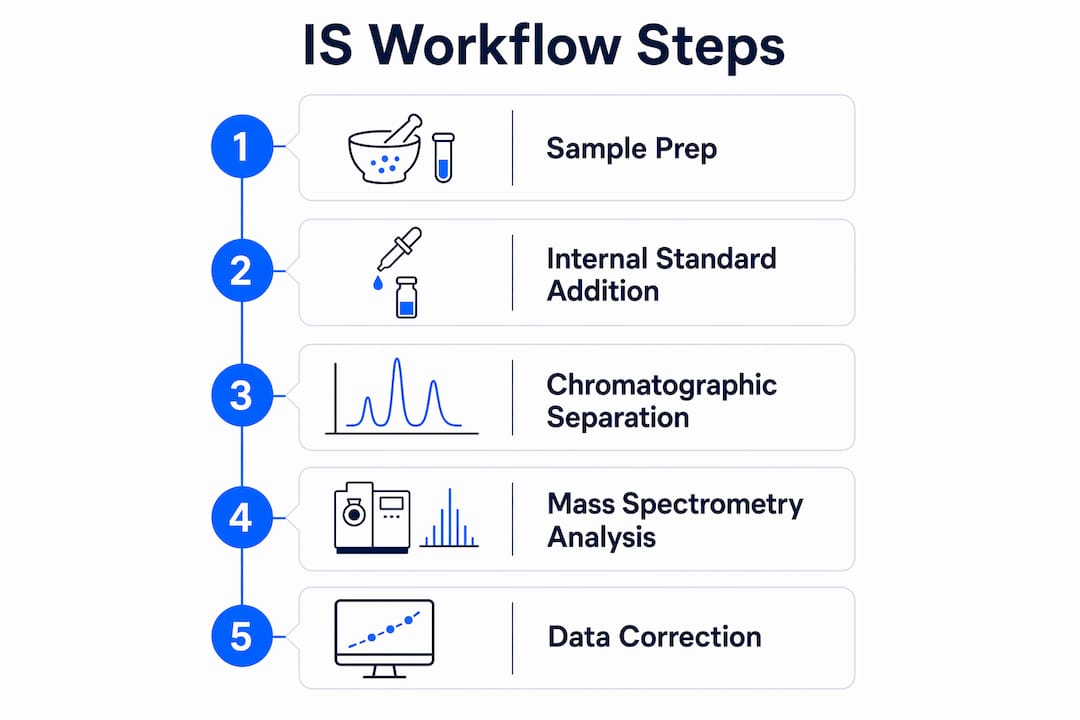
Selecting the wrong internal standard is the most common source of systematic bias in LC-MS/MS methods. Matching IS to analyte requires alignment across three properties: retention time, ionization characteristics, and extraction recovery behavior. Structural similarity alone is insufficient.
The selection process follows a defined hierarchy:
- Stable isotope-labeled analogs (SILs): Deuterium, carbon-13, or nitrogen-15 labeled versions of the analyte are the first choice. They are chemically identical to the analyte in all chromatographic and ionization properties, differing only in mass. IDMS using SIL standards is recognized for high-accuracy characterization of certified reference materials precisely because of this near-perfect behavioral matching.
- Structural analogs: Compounds with similar but not identical structures. These are acceptable only when SILs are unavailable and when the analyst has completed rigorous matrix-matched validation. Structural analogs often fail to track extraction efficiency as effectively as SILs in complex matrices, introducing quantitative deviations that are difficult to detect without extensive cross-validation.
- Surrogate internal standards: Used in specific applications where neither a SIL nor a close structural analog exists. These require the most extensive validation and carry the highest risk of method-specific bias.
Retention time matching deserves particular attention. An IS that elutes 2 minutes before or after the analyte will experience a different matrix environment at the ionization source. The matrix effect correction will be incomplete, and the resulting bias may be directional, meaning it will consistently over- or underestimate concentration.
Ionization characteristics must also match. An analyte that ionizes primarily as an ammonium adduct in positive mode requires an IS with the same adduct formation tendency. Mismatched adduct profiles produce non-linear IS response, which breaks the ratiometric calculation at high or low concentration extremes.
Concentration selection for the IS matters as well. The IS should be added at a concentration that places its signal in the linear range of the detector, typically near the midpoint of the calibration range. Adding IS at too high a concentration risks detector saturation and cross-talk into the analyte channel.
Pro Tip: Always evaluate IS performance across the full matrix panel used in your study, not just in neat solvent. A SIL that performs well in phosphate-buffered saline may behave differently in hemolyzed plasma or lipemic serum.
What are the different types of internal standards and their applications?
The taxonomy of mass spec internal standards maps directly onto the analytical challenges each type addresses. Understanding the trade-offs between types allows analysts to make defensible choices when SILs are unavailable or cost-prohibitive.
Stable isotope-labeled internal standards dominate regulated bioanalysis, environmental monitoring under EPA methods, and food safety testing under EU Regulation 2021/808. Their behavioral identity with the analyte means they correct for matrix effects, extraction losses, and ionization variability simultaneously. IDMS relies heavily on isotopically labeled IS to provide superior correction for matrix effects, and this technique is the reference method for primary standard characterization at national metrology institutes.
Structural analogs serve as practical alternatives when SILs are not commercially available. Their limitations are well documented. Alternatives to SILs may fail to mirror analyte behavior during ionization or extraction, causing quantitative errors that compound across complex matrices. Analysts using structural analogs must validate recovery, matrix factor, and process efficiency independently for each matrix type.
Surrogate internal standards are spiked into samples before extraction to track the entire sample preparation process. They are distinct from the primary IS in that they are not necessarily structurally related to the target analyte. Surrogate IS are common in environmental analysis, where target analytes may number in the hundreds and SILs for each are impractical.
| IS type | Primary use case | Key advantage | Key limitation |
|---|---|---|---|
| Stable isotope-labeled (SIL) | Regulated bioanalysis, IDMS | Near-perfect analyte tracking | High cost, limited availability |
| Structural analog | Research-grade methods | Lower cost, wider availability | Requires extensive matrix validation |
| Surrogate IS | Environmental, multi-analyte panels | Tracks full extraction process | No ionization correction guarantee |
Key considerations when choosing between types:
- SILs with three or more heavy atoms are preferred over deuterium-labeled analogs in some applications, because deuterium can exchange with solvent under certain conditions.
- Structural analogs require a minimum of three matrix types in validation to establish cross-matrix applicability.
- Surrogate IS should be added at the earliest possible step in sample preparation to capture maximum process variability.
How are internal standards practically implemented in mass spectrometry workflows?
Practical implementation of internal standards determines whether their theoretical advantages translate into real data quality. The two critical variables are addition method and concentration consistency.
Variability in IS addition method is a leading cause of poor IS performance in routine workflows. Manual pipetting introduces volume errors of 1–3% per transfer under ideal conditions, and higher errors when analysts are fatigued or when viscous matrices are involved. Automated dosing systems, including peristaltic pumps and valve-based dispensers, reduce this variability substantially. For high-throughput regulated laboratories, automated IS addition is not optional. It is the only way to maintain the concentration consistency required for valid ratio calculations.
Consistency in IS concentration across all samples and standards is necessary for valid ratio calculations. Any sample that receives a different IS volume than the others will produce a biased analyte-to-IS ratio. This bias is invisible in the raw data and only detectable through IS signal monitoring.
Monitoring IS intensity across a batch is an active quality control task, not a passive check. Deviation in IS intensity in a specific sample signals a potential analytical flaw, whether from a matrix effect, a pipetting error, or a sample-specific interference. Analysts should set IS intensity acceptance windows, typically ±20% of the batch mean, and flag any sample outside that window for reinvestigation before reporting results.
Practical implementation checklist:
- Add IS to samples before any extraction or dilution step to capture maximum process variability.
- Prepare IS working solutions fresh or validate stability under storage conditions before use.
- Monitor IS signal in every injection, including blanks, to detect carryover or contamination.
- Document IS lot numbers and concentrations in every analytical run record for traceability.
- Investigate any IS signal trend across a batch, because a gradual decline indicates source fouling or IS degradation rather than a single sample anomaly.
Active IS signal monitoring serves as an early warning system for matrix or instrument issues before formal data validation. This is one of the most underused quality control tools in routine mass spectrometry laboratories.
What I have learned from years of working with internal standards
The single most consequential decision in any quantitative mass spectrometry method is the choice of internal standard. I have seen well-funded studies produce unreliable data because the analyst selected a structural analog without completing matrix-matched validation. The error was not visible in the calibration curve. It appeared only when the method was transferred to a different matrix type and the IS recovery diverged from the analyte recovery by 30%.
The cost argument against SILs is real but often overstated. A SIL that costs $400 per gram protects a study that may cost $200,000 to run. The economics favor the SIL in almost every regulated context. Where cost genuinely prohibits SIL use, the validation burden on the structural analog must be proportionally higher, not lower.
Regulatory-grade analytical confidence requires SIL internal standards as the default, not the exception. Agencies reviewing bioanalytical data expect to see SIL IS use justified or its absence explained with compensating validation data.
The future of internal standard use in mass spectrometry will be shaped by two forces: the expansion of untargeted metabolomics, where universal IS coverage is impossible, and the growth of automated sample preparation platforms that make consistent IS addition achievable at scale. Analysts who build IS monitoring into their software workflows now will be better positioned as data volumes increase.
— Nadeem
R2nsoftware tools for internal standard monitoring and data analysis
Accurate quantitative mass spectrometry depends on software that can process IS-corrected data without introducing computational artifacts. R2nsoftware builds analytical tools specifically for this level of rigor.

AutoSingal automates signal processing and IS correction in mass spectrometry data, reducing the manual steps that introduce variability in IS ratio calculations. PeakLab applies advanced mathematical algorithms to peak fitting and baseline correction, supporting workflows where overlapping signals and complex matrices demand more than standard integration routines. Both tools are built for analysts who treat IS monitoring as a quantitative discipline, not an afterthought. Explore R2nsoftware’s full analytical software catalog to find the right solution for your mass spectrometry workflow.
Key takeaways
Internal standards are the primary mechanism for achieving accurate, reproducible quantitative results in mass spectrometry, and their selection, addition method, and monitoring protocol determine whether that accuracy is realized in practice.
| Point | Details |
|---|---|
| IS function | Internal standards correct for matrix effects, extraction losses, and ionization variability through ratiometric calculation. |
| SIL standards are the benchmark | Stable isotope-labeled analogs track analyte behavior most accurately and are required for regulatory-grade methods. |
| Selection criteria | Match IS to analyte by retention time, ionization characteristics, and extraction recovery, not structural similarity alone. |
| Addition consistency | Automated IS dosing reduces volume variability and is necessary for high-throughput regulated workflows. |
| IS monitoring as quality control | Tracking IS signal intensity across a batch detects matrix effects and instrument issues before data validation. |
FAQ
What is the role of internal standards in mass spectrometry?
Internal standards correct for variability in sample preparation, injection volume, and ionization efficiency by providing a reference signal that experiences the same conditions as the analyte. The analyte-to-IS ratio eliminates these sources of error from the final quantitative result.
Why are stable isotope-labeled standards preferred over structural analogs?
SIL standards are chemically identical to the analyte in chromatographic and ionization behavior, so they track matrix effects and extraction losses with near-perfect fidelity. Structural analogs often fail to mirror analyte behavior during ionization or extraction, causing quantitative deviations in complex matrices.
How should IS concentration be selected for a mass spectrometry method?
The IS concentration should place its detector signal within the linear range of the instrument, typically near the midpoint of the calibration curve. Concentrations that are too high risk detector saturation; concentrations that are too low reduce the precision of the ratio calculation.
What does a drop in IS signal intensity indicate during a run?
A deviation in IS intensity in a specific sample signals a potential analytical flaw, such as a matrix effect, pipetting error, or sample-specific interference. Analysts should set IS intensity acceptance windows and reinvestigate any sample outside those limits before reporting data.
Can one internal standard cover multiple analytes in a panel?
A single IS can cover multiple analytes only when those analytes share nearly identical retention times, ionization characteristics, and matrix behavior. For panels with analytes spread across a chromatographic run, multiple IS compounds are required to maintain effective matrix effect correction across all retention time windows.