High Resolution Mass Spectrometry: A Researcher’s Guide
High resolution mass spectrometry (HRMS) is defined as an analytical technique that measures exact molecular masses with resolving powers exceeding 100,000, enabling differentiation of ions separated by as little as 0.0001 unified atomic mass units. That level of precision transforms molecular identification from an approximation into a definitive assignment. HRMS is the standard technique in proteomics, pharmaceutical analysis, environmental chemistry, and clinical toxicology, where nominal mass data is insufficient for confident compound identification. Orbitrap technology and Fourier transform ion cyclotron resonance (FT-ICR) represent the two dominant instrument platforms driving this capability.
What is high resolution mass spectrometry, and how does it work?
HRMS is the formal industry term for mass spectrometry performed at resolving powers sufficient to measure exact masses rather than nominal masses. Resolving power is defined by the formula R = m/Δm, where m is the measured mass and Δm is the minimum resolvable mass difference between two adjacent ions. The valley between those two peaks is typically specified at 50% or 10% of peak height, depending on the instrument and application context.
Standard mass spectrometry rounds measurements to the nearest integer, producing nominal masses. HRMS delivers four or more decimal places in mass measurements, which makes molecular formula deduction possible. That distinction is not incremental. It is the difference between identifying a compound class and identifying a specific molecular formula.
Mass accuracy in HRMS is typically reported in parts per million (ppm) and is often better than 5 ppm on modern instruments. Mass accuracy and resolving power are related but distinct metrics. Resolving power separates overlapping peaks; mass accuracy assigns the correct molecular formula to each resolved peak. Both are required for confident data interpretation.
How does HRMS differ from standard mass spectrometry?
Standard mass spectrometry instruments, including single quadrupole and ion trap analyzers, typically operate at resolving powers below 10,000. At that level, two compounds sharing the same nominal mass appear as a single unresolved peak. The researcher cannot distinguish them by mass alone.
HRMS resolves this problem directly. Consider cyclopentanone (exact mass 84.0573 u) and cyclohexane (exact mass 84.0936 u). Both have a nominal mass of 84. Standard MS cannot separate them, but HRMS resolves the 0.0363 u difference without ambiguity. That capability is the practical core of what makes HRMS indispensable in complex sample matrices.
The analogy to photography is technically accurate here. Low resolution produces blurred spectral data where overlapping signals merge into a single unresolved peak, leading to incorrect identification or quantification. High resolution produces sharp, distinct peaks that can each be assigned a molecular formula.
Pro Tip: Researchers frequently confuse mass resolution with mass accuracy. Resolution determines whether two peaks can be separated. Accuracy determines whether the mass of a resolved peak is correctly assigned. An instrument can have high resolving power but poor mass accuracy if calibration is inadequate. Always verify both parameters before reporting molecular formulas.
What types of HRMS instruments are commonly used?
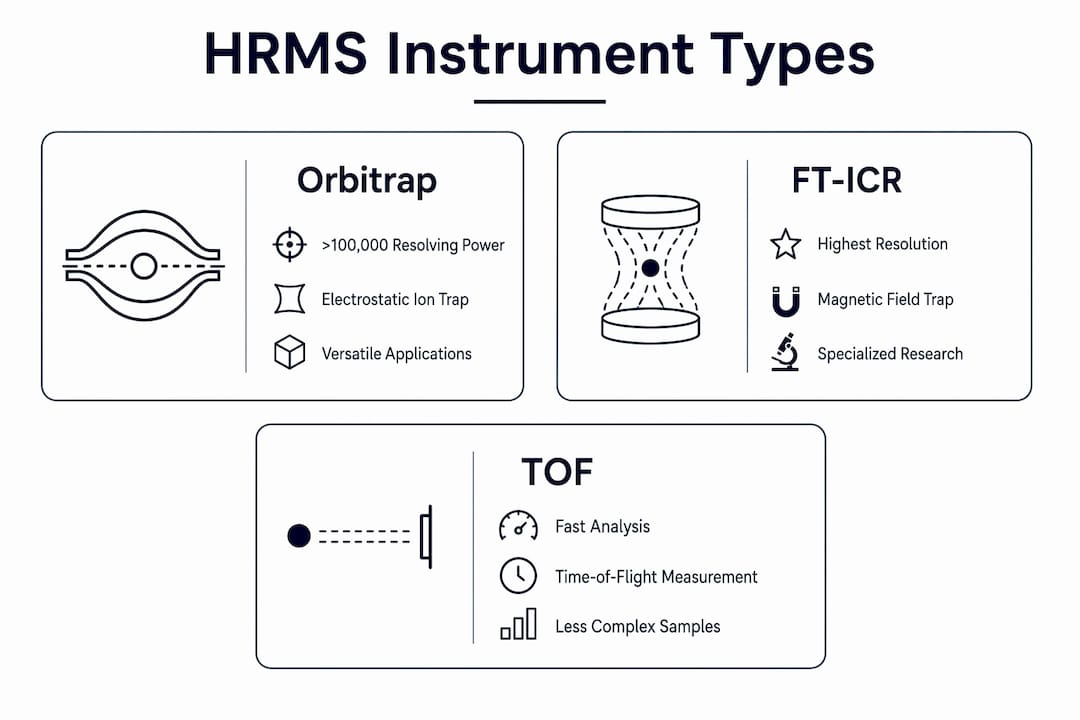
Three instrument platforms dominate high resolution mass spectrometry work in research and regulated environments. Each operates on a different physical principle and delivers a different performance profile.
| Instrument Type | Typical Resolving Power | Primary Strengths | Common Applications |
|---|---|---|---|
| Orbitrap | >100,000 | High mass accuracy, broad dynamic range | Proteomics, pharmaceutical QC, metabolomics |
| FT-ICR | >500,000 | Highest resolving power available | Petroleomics, natural product research |
| Time-of-flight (TOF) | 10,000–50,000 | Fast acquisition, good sensitivity | Screening, food safety, environmental analysis |
Orbitrap analyzers trap ions in an electrostatic field and measure their oscillation frequency. That frequency correlates directly with mass-to-charge ratio. The result is resolving power above 100,000 with mass accuracy routinely below 5 ppm, making Orbitrap the standard platform for regulated pharmaceutical analysis.
FT-ICR instruments measure the cyclotron frequency of ions trapped in a magnetic field. They deliver the highest resolving powers available in any commercial mass spectrometer, often exceeding 500,000. The tradeoff is instrument cost, size, and the requirement for superconducting magnets maintained at cryogenic temperatures.
TOF instruments measure the time an ion takes to travel a fixed distance after acceleration. They are faster and less expensive than Orbitrap or FT-ICR systems, but lower resolving power in TOF instruments introduces risks of unresolved background interference in complex matrices. TOF platforms remain valuable for high-throughput screening where speed outweighs the need for maximum resolution.
What are the main applications and benefits of high resolution mass spectrometry?
HRMS delivers measurable advantages across a range of research and industrial contexts. The core benefit is the ability to determine elemental composition from exact mass data, which is not possible with nominal mass instruments.
Key application areas include:
- Proteomics and metabolomics: HRMS resolves isobaric peptides and metabolites that share nominal masses, enabling confident protein identification and metabolic pathway mapping.
- Pharmaceutical analysis: Orbitrap-based systems are required in regulated pharmaceutical workflows to separate isobaric impurities and confirm molecular formulas of drug substances and degradation products.
- Clinical toxicology: HRMS detects trace-level compounds in biological matrices where co-eluting interferences would cause false negatives on lower resolution platforms.
- Environmental chemistry: Exact mass measurement identifies unknown contaminants in water and soil samples without reference standards, using molecular formula assignment alone.
- Extractables and leachables testing: Regulated industries including medical device manufacturing rely on HRMS for safety and compliance testing, where false positives or false negatives carry direct regulatory consequences.
- Polymer and materials chemistry: HRMS characterizes complex polymer distributions and identifies trace additives at concentrations that nominal mass instruments cannot resolve.
The specificity advantage of HRMS extends beyond identification. Quantification accuracy improves when the analyte peak is fully resolved from matrix interferences. Researchers working with resolving overlapping mass spec signals understand that unresolved peaks produce systematic quantification errors that no post-processing correction can fully eliminate.
What practical challenges should researchers consider with HRMS data?
HRMS data interpretation carries specific pitfalls that researchers must account for before drawing structural conclusions. The most common error is treating high mass accuracy as sufficient evidence for molecular structure.
HRMS cannot distinguish structural isomers with identical molecular formulas. Propanal and propanone both have the molecular formula C₃H₆O and identical exact masses. Tandem MS fragmentation is required to differentiate them through characteristic fragment ions. HRMS provides the molecular formula; MS/MS provides the structural evidence.
Researchers should also account for these practical considerations:
- Resolving power selection: Higher resolving power increases scan time and reduces sensitivity in some instrument configurations. Selecting appropriate resolving power for the specific matrix and analyte concentration is a scientific decision, not a default setting.
- Calibration frequency: Mass accuracy degrades without regular external or internal calibration. Internal calibration with a lock mass compound is the most reliable approach for sub-2 ppm accuracy.
- Dynamic range limitations: High-abundance matrix components can suppress or mask low-abundance analyte signals even when resolving power is sufficient to separate them spectrally.
- Data file size and processing load: HRMS generates substantially larger data files than nominal mass instruments. Processing workflows must handle this volume without introducing peak-picking errors.
Pro Tip: For trace analysis in complex biological or environmental matrices, set resolving power to the maximum your instrument supports for the target scan rate. The sensitivity cost is typically smaller than the specificity gain from fully resolving matrix interferences.
Key Takeaways
High resolution mass spectrometry delivers molecular formula certainty that nominal mass instruments cannot provide, making it the definitive technique for complex sample identification in research and regulated industries.
| Point | Details |
|---|---|
| Resolving power defines HRMS | R = m/Δm exceeding 100,000 separates ions differing by as little as 0.0001 u. |
| Mass accuracy enables formula assignment | Accuracy better than 5 ppm allows unequivocal elemental composition determination. |
| Instrument choice affects performance | Orbitrap and FT-ICR outperform TOF in resolving power and mass accuracy for complex matrices. |
| HRMS cannot replace MS/MS | Structural isomers require tandem fragmentation data beyond exact mass measurement alone. |
| Resolving power must be optimized | Selecting the correct resolving power setting balances sensitivity, scan speed, and specificity. |
HRMS in practice: what years of instrument work actually reveal
The technical specifications of HRMS instruments are well documented. What the literature covers less thoroughly is the gap between instrument capability and analytical outcome in real laboratory conditions.
I have seen researchers invest in Orbitrap platforms and then process the resulting data with peak-picking algorithms designed for nominal mass instruments. The resolving power was there. The data quality was not. The instrument delivered sub-5 ppm mass accuracy, but the software introduced peak centroid errors that negated that accuracy at the reporting stage. The bottleneck was never the hardware.
The integration of HRMS with advanced signal processing software is where the actual analytical gains are realized. Instruments like Orbitrap systems generate data with extraordinary information density. Extracting that information requires peak fitting models that account for the actual peak shape, including asymmetry, tailing, and baseline drift. Generic Gaussian fitting underestimates peak areas in tailing chromatographic peaks and overestimates them in fronting ones. That error propagates directly into quantification.
The other underappreciated challenge is isobaric compound separation in real matrices. Textbook examples use clean standards. Real samples contain hundreds of co-eluting compounds, and even at resolving power above 100,000, some pairs remain unresolved without chromatographic separation upstream. HRMS and liquid chromatography are not alternatives. They are complementary, and the data analysis layer must handle both dimensions simultaneously.
My consistent recommendation is to treat the data processing workflow with the same rigor applied to instrument selection. The scientific validity of HRMS data depends on both.
— Nadeem
How R2nsoftware supports HRMS data analysis workflows
HRMS instruments generate data of exceptional density and complexity. Extracting accurate peak areas, resolving overlapping signals, and modeling baselines correctly requires software built for that level of analytical demand.
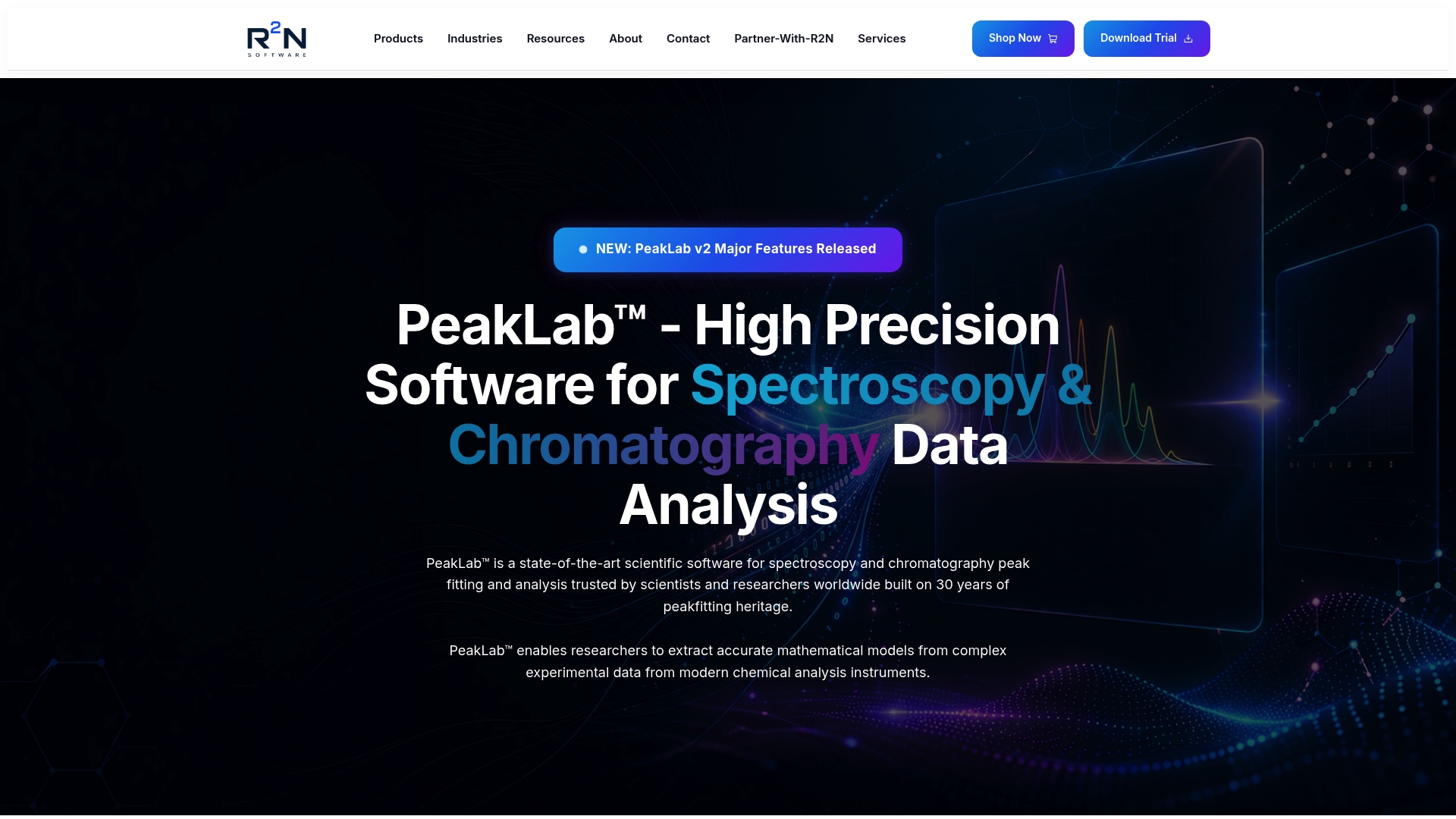
R2nsoftware’s PeakLab applies advanced mathematical algorithms and statistical models to HRMS peak fitting, supporting up to 1,000 peaks simultaneously. That capacity directly addresses the signal congestion common in proteomics and pharmaceutical HRMS datasets. The AutoSingal tool provides automated peak detection and signal analysis designed for the high-information-density outputs that Orbitrap and FT-ICR instruments produce. Researchers working across chromatography, spectroscopy, and mass spectrometry workflows can apply R2nsoftware’s solutions to convert raw HRMS data into scientifically defensible quantitative results.
FAQ
What is the resolving power of a high resolution mass spectrometer?
Modern HRMS instruments, particularly Orbitrap analyzers, achieve resolving powers exceeding 100,000, defined by R = m/Δm. That level separates ions differing by as little as 0.0001 unified atomic mass units.
How does HRMS differ from standard mass spectrometry?
Standard mass spectrometry reports nominal masses rounded to the nearest integer, while HRMS measures exact masses to four or more decimal places. This enables molecular formula determination that nominal mass data cannot support.
Can HRMS identify structural isomers?
HRMS alone cannot distinguish structural isomers that share the same molecular formula and exact mass. Tandem MS/MS fragmentation data is required to differentiate compounds like propanal and propanone.
What mass accuracy does HRMS typically achieve?
HRMS instruments routinely achieve mass accuracy better than 5 ppm with proper calibration. That accuracy is sufficient for unequivocal elemental composition assignment in most research and regulated analytical contexts.
Which industries rely most on HRMS?
Pharmaceutical analysis, clinical toxicology, proteomics, environmental chemistry, and medical device manufacturing all depend on HRMS. Regulated applications such as extractables and leachables testing specifically require the resolving power that HRMS platforms provide.