Benefits of High-Resolution MS Analysis for Researchers
High-resolution mass spectrometry (HRMS) is defined as a mass spectrometry technique that measures ionic masses with sub-ppm accuracy, enabling confident molecular formula assignment in complex mixtures. The benefits of high-resolution MS analysis extend well beyond simple mass measurement. HRMS achieves resolving power up to 100,000, making it the standard method for differentiating isobaric compounds in matrices where low-resolution instruments produce ambiguous or misleading results. Applications span metabolomics, pharmaceutical research, environmental monitoring, and proteomics, where accurate identification of low-abundance analytes determines the scientific validity of the entire study.
1. Benefits of high-resolution MS analysis for isobaric compound discrimination
Resolving isobaric compounds is the defining capability of HRMS. Two molecules sharing a nominal mass but differing in elemental composition will appear as a single peak on a low-resolution instrument. Resolutions up to 100,000 differentiate isobaric compounds and prevent false positives and negatives in complex samples such as horse-feed extracts containing more than 100 pesticides simultaneously.

Sub-ppm mass error is the metric that makes this discrimination reliable. When an instrument reports a mass within 1–2 ppm of the theoretical value, the number of plausible elemental compositions drops sharply. That reduction directly lowers misidentification risk and strengthens the scientific defensibility of reported results.
Key analytical gains from high resolving power include:
- Separation of co-eluting isobaric species without requiring additional chromatographic steps
- Accurate elemental composition assignment from exact mass alone
- Reduction of matrix-related false positives in pesticide, drug, and environmental screening
- Confident identification of unknown compounds through molecular formula generation
Only resolving power above 15,000 prevents incorrect compositional assignments. Instruments operating below that threshold introduce systematic errors that propagate through every downstream calculation.
Pro Tip: Excessively high resolution settings reduce ion transmission and lower sensitivity. Set resolving power to the minimum value that separates your target isobaric pair, then verify ion counts remain within your quantitation range before finalizing the method.
2. Simultaneous qualitative and quantitative analysis
LC-HRMS supports simultaneous qualitative and quantitative analysis critical for drug metabolite research where analyte concentrations fall below the detection threshold of traditional HPLC or GC methods. This dual capability eliminates the need to run separate analytical sequences for identification and quantitation, cutting instrument time and sample consumption.
The practical advantages of combined LC-HRMS workflows include:
- Structural elucidation of unknown metabolites from fragment ion spectra collected in the same run
- Quantitation of parent drug and multiple metabolites from a single injection
- Detection of low-abundance analytes that would be lost in conventional low-resolution workflows
- Retrospective data mining, where archived raw files are reprocessed against new compound libraries without re-injecting samples
Retrospective analysis is one of the most underappreciated high-resolution mass analysis benefits. Because HRMS records full-spectrum data at every scan, researchers can query a dataset months after acquisition for compounds that were not part of the original target list. Low-resolution selected-reaction monitoring workflows cannot do this.
3. Metabolite identification and biological pathway mapping
Sub-ppm mass error and isotope pattern analysis reduce misidentification risk in metabolomics studies where hundreds of structurally similar compounds co-exist in a single biological matrix. Isotope pattern matching adds a second orthogonal filter beyond exact mass, confirming elemental composition by comparing theoretical and observed isotope ratios.
The impact on biological research is direct:
- Pharmacokinetics studies benefit from confident metabolite tracking across plasma, urine, and tissue matrices
- Toxicology workflows gain the ability to distinguish phase I and phase II metabolites without reference standards
- Proteomics studies use fragment ion ladders from HRMS to sequence peptides and assign post-translational modifications
“Integration of automated workflows in high-resolution proteomics data processing is essential to reduce human bias, enhance reproducibility, and efficiently leverage HRMS capabilities.”
Frag’n’Flow automated pipeline
Automated pipelines like Frag’n’Flow integrated with Nextflow optimize HRMS-based proteomics data processing, reducing manual bias and supporting FAIR data principles. Automation is not optional at scale. A proteomics study generating thousands of spectra per day cannot rely on manual curation without introducing operator-dependent variability that undermines reproducibility.
4. Environmental and pharmaceutical impurity profiling
HRMS provides higher selectivity and sensitivity in impurity profiling and complex sample analysis, surpassing traditional techniques like thin-layer chromatography and standard HPLC. The regulatory pressure on pharmaceutical manufacturers to characterize trace impurities at the 0.05% threshold and below makes HRMS the only practical tool for comprehensive profiling.
Environmental monitoring presents a parallel challenge. Surface water samples contain hundreds of anthropogenic contaminants at nanogram-per-liter concentrations. HRMS resolves co-eluting contaminants that would merge into a single unresolvable signal on a low-resolution platform, and its full-scan acquisition captures emerging contaminants that were not part of the original monitoring program.
The combination of high mass accuracy and full-spectrum acquisition means a single analytical run can serve both regulatory compliance and exploratory research goals. That dual utility justifies the instrument investment for laboratories operating in both pharmaceutical and environmental sectors.
5. Sensitivity and dynamic range trade-offs with low-resolution MS
HRMS generally shows lower sensitivity and dynamic range than low-resolution MS, making it best utilized as a complementary tool rather than a total replacement in clinical and forensic toxicology. This is the most frequently misunderstood aspect of HRMS adoption.
A practical dual-platform strategy follows this sequence:
- Run initial screening on a low-resolution triple-quadrupole instrument for maximum sensitivity and throughput.
- Flag suspect positives from the screening pass for confirmation.
- Inject flagged samples on the HRMS platform to confirm molecular formula and eliminate isobaric false positives.
- Report confirmed identifications with exact mass, isotope pattern match score, and fragment ion evidence.
- Archive full-scan HRMS data for retrospective queries against updated compound libraries.
LRMS ensures higher sensitivity while HRMS provides definitive structural confirmation. The two platforms address different analytical questions and perform best when used together.
Pro Tip: When tuning HRMS instrument parameters for trace analysis, reduce the resolving power setting incrementally and monitor signal-to-noise ratio at each step. The optimal setting is the lowest resolving power that still separates your critical isobaric pair, maximizing ion transmission without sacrificing identification confidence.
6. Comparing HRMS analyzer types: performance trade-offs
TOF, Orbitrap, and FT-ICR analyzers differ in resolution and application suitability, with some platforms exceeding 500,000 resolving power for specialized applications. Selecting the right analyzer type depends on the specific demands of your research workflow.
| Analyzer type | Typical resolving power | Mass accuracy | Best application |
|---|---|---|---|
| Time-of-flight (TOF) | 20,000–60,000 | 1–5 ppm | High-throughput metabolomics, food safety |
| Orbitrap | 60,000–500,000 | <1 ppm | Proteomics, pharmaceutical impurity profiling |
| FT-ICR | >500,000 | <0.5 ppm | Petroleomics, ultrahigh-complexity mixtures |
| Quadrupole-TOF (Q-TOF) | 20,000–50,000 | 1–5 ppm | Drug metabolism, environmental screening |
TOF instruments offer the highest acquisition speed, making them well suited for fast chromatographic separations. Orbitrap platforms deliver the best balance of resolving power and quantitative accuracy for most pharmaceutical and proteomics workflows. FT-ICR instruments provide the highest absolute resolution but require specialized infrastructure and are reserved for applications where no other analyzer can resolve the target species.
Researchers selecting an HRMS platform should prioritize the resolving power required to separate their most challenging isobaric pair, then evaluate sensitivity, dynamic range, and data system capabilities as secondary criteria. Tools like PeakLab from R2nsoftware support post-acquisition data processing across these analyzer types, handling overlapping signal deconvolution and baseline correction for up to 1,000 peaks simultaneously.
Key takeaways
High-resolution mass spectrometry delivers its greatest analytical value when resolving power, mass accuracy, and automated data workflows are matched to the specific complexity of the sample matrix.
| Point | Details |
|---|---|
| Resolving power threshold | Resolving power above 15,000 is required to prevent incorrect elemental composition assignments. |
| Isobaric discrimination | Sub-ppm mass error combined with isotope pattern matching eliminates false positives in complex matrices. |
| Dual-platform strategy | Pairing low-resolution MS for screening with HRMS for confirmation maximizes both sensitivity and identification confidence. |
| Automated workflows | Pipelines like Frag’n’Flow reduce manual bias and improve reproducibility in large-scale HRMS studies. |
| Retrospective data mining | Full-scan HRMS acquisition enables reprocessing of archived data against new compound libraries without re-injection. |
What I have learned from integrating HRMS into complex workflows
The most common mistake I see in HRMS adoption is treating resolving power as a dial to maximize rather than a parameter to calibrate. Researchers push instruments to 100,000 or beyond because the specification looks impressive, then wonder why their signal-to-noise ratio collapses on low-abundance analytes. The physics is straightforward: higher resolving power narrows the mass window, which reduces ion transmission and lowers sensitivity. The right resolving power is the one that separates your hardest isobaric pair, not the highest number the instrument can produce.
The second lesson is that automation is not a convenience. It is a reproducibility requirement. Manual peak integration across thousands of HRMS spectra introduces operator-dependent variability that no statistical correction can fully remove. Automated deconvolution and overlapping signal resolution tools eliminate that variability at the source. Laboratories that resist automation in their HRMS workflows are producing data that cannot be fully trusted at scale.
The third point is one that the field is slow to accept: HRMS does not replace low-resolution MS in every context. Clinical toxicology laboratories that abandoned their triple-quadrupole instruments entirely in favor of HRMS platforms found themselves struggling with sensitivity on dilute urine samples. The complementary strategy is not a compromise. It is the correct analytical design.
— Nadeem
R2nsoftware tools for high-resolution MS data analysis
Translating raw HRMS data into defensible results requires software that can handle the scale and complexity of modern high-resolution datasets.
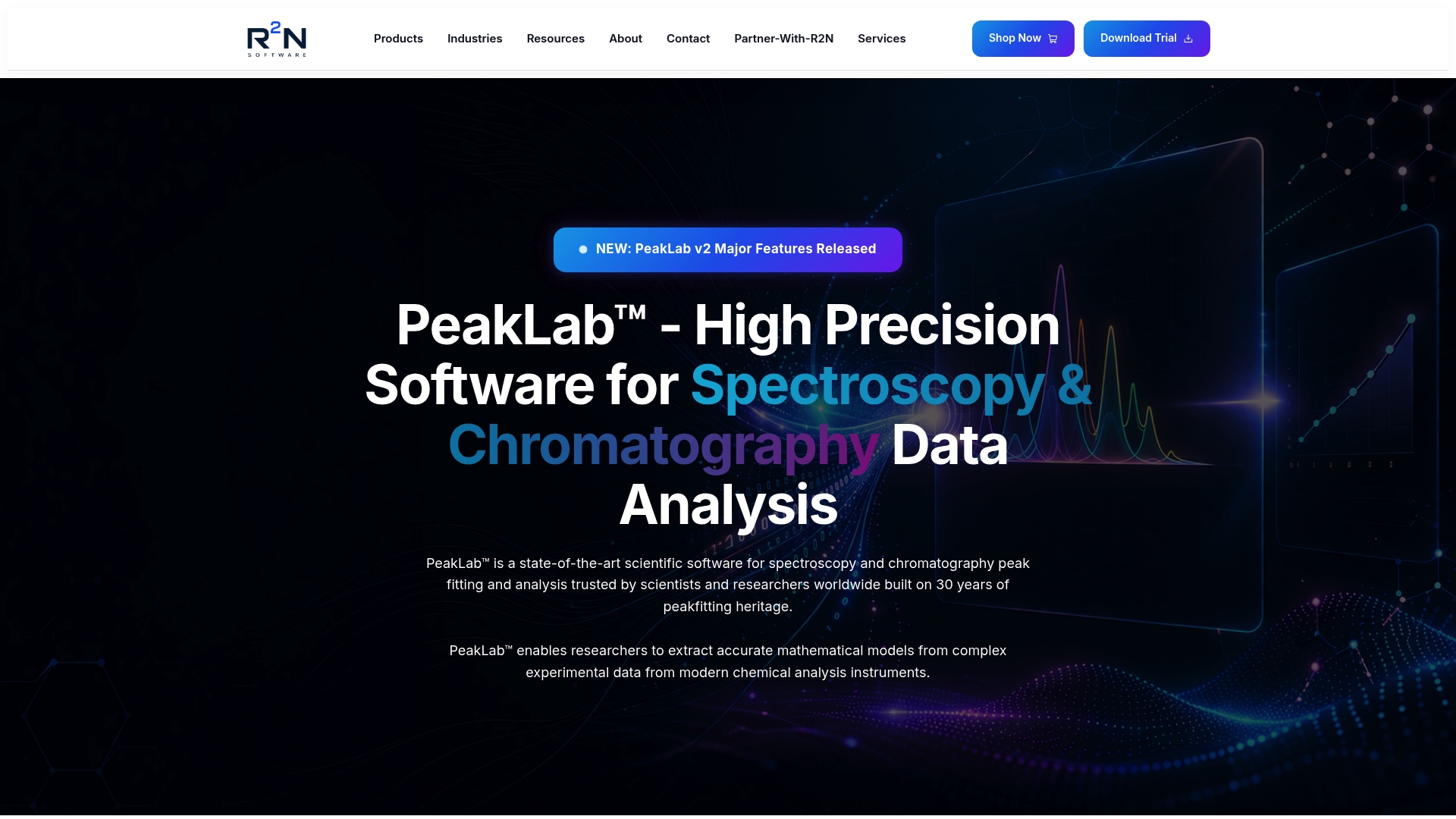
R2nsoftware’s PeakLab addresses the core computational challenges in HRMS workflows: overlapping peak deconvolution, baseline modeling, and simultaneous fitting of up to 1,000 peaks using advanced mathematical algorithms including Gaussian, Lorentzian, and Voigt functions. For researchers working with automatic signal detection across large HRMS datasets, AutoSingal provides automated peak detection and processing optimized for high-resolution spectral data. Both tools produce reproducible, scientifically defensible outputs that meet the documentation standards required in pharmaceutical, environmental, and proteomics research.
FAQ
What resolving power does HRMS require for isobaric separation?
Resolving power above 15,000 is the minimum threshold to prevent incorrect elemental composition assignments. Complex matrices like pesticide-laden food extracts typically require resolutions up to 100,000 to fully separate isobaric interferences.
Can HRMS replace low-resolution MS in clinical toxicology?
HRMS does not replace low-resolution MS in clinical and forensic toxicology. Low-resolution instruments retain superior sensitivity and dynamic range for high-throughput screening, while HRMS confirms suspect positives and eliminates isobaric false positives.
What is retrospective data mining in HRMS?
Retrospective data mining is the reprocessing of archived full-scan HRMS files against updated compound libraries without re-injecting samples. This capability is unique to full-scan HRMS acquisition and is not available with targeted low-resolution workflows.
Which HRMS analyzer type suits pharmaceutical impurity profiling?
Orbitrap analyzers are the standard choice for pharmaceutical impurity profiling, delivering resolving power from 60,000 to 500,000 and sub-ppm mass accuracy suited to trace-level characterization at regulatory thresholds.
How does automated data processing improve HRMS reproducibility?
Automated pipelines like Frag’n’Flow reduce manual operator bias in large-scale HRMS datasets and support FAIR data principles. Manual peak integration across thousands of spectra introduces variability that automated deconvolution tools eliminate at the source.