
How Background Subtraction Works in Mass Spec

Background subtraction in mass spectrometry is defined as the computational removal of non-analyte signals from raw spectral data to reveal true analyte peaks with greater accuracy. Every mass spectrometry dataset contains background signals from instrumental noise, column bleed, and atmospheric contaminants. These interference signals distort baseline measurements and compromise analyte identification if left uncorrected. Understanding how background subtraction works in mass spec is therefore a prerequisite for defensible mass spectrometry data analysis, whether the application is metabolomics, proteomics, or environmental monitoring.
What are the main sources of background signals in mass spectrometry?
Background signals in mass spectrometry originate from multiple sources, each contributing differently to baseline elevation and spectral complexity. Recognizing these sources is the first step toward selecting the correct subtraction strategy.
Instrumental noise and baseline elevation arise from detector dark current, electronic interference, and thermal fluctuations within the instrument. These signals are continuous and affect the entire mass range, raising the apparent baseline across all scans.
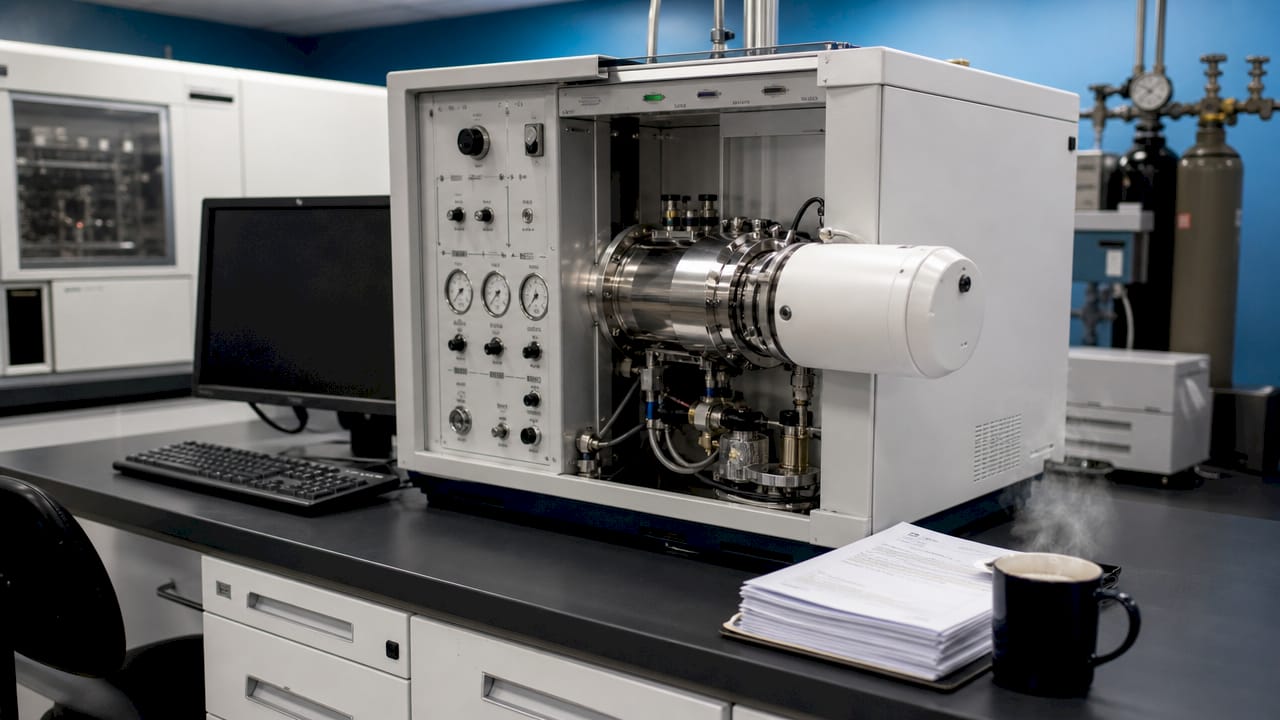
Atmospheric contaminants are among the most predictable background contributors. Water at m/z 18, nitrogen at m/z 28, and oxygen at m/z 32 are consistently present in GC-MS systems that are not perfectly sealed. These ions inflate the low-mass region of every spectrum.
Column bleed produces high-molecular-weight siloxane fragment ions, particularly in GC-MS, when the stationary phase degrades at elevated temperatures. These ions appear at characteristic m/z values and increase with column age or thermal stress.
The practical consequences of these sources differ depending on the chromatographic output examined:
- Total ion chromatograms (TIC) sum all detected ions across the full mass range. They are highly sensitive to background elevation because every contaminating ion contributes to the total count.
- Extracted ion chromatograms (EIC) isolate a single m/z or narrow mass window. They are far less susceptible to broad background interference and provide more selective analysis for targeted compounds.
Excluding ions below m/z 40 is standard practice in GC-MS method setup. This single step eliminates the dominant atmospheric contaminant ions and prevents their bulk contribution from masking analyte signals at higher mass values.
How do computational methods perform background subtraction in mass spec?
Computational background subtraction applies mathematical operations to spectral data to isolate and remove non-analyte signal contributions. Two primary algorithmic categories cover most practical scenarios: persistent subtraction and plot-specific subtraction.
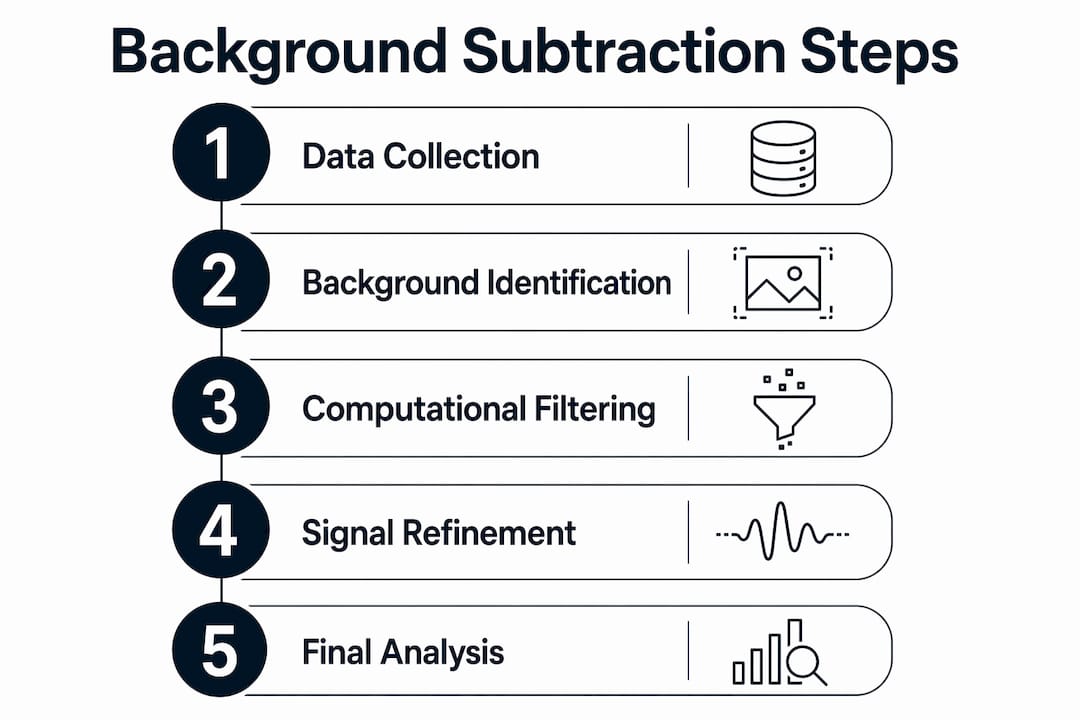
Persistent background subtraction, implemented through functions such as set_bg, modifies all subsequent data in an analysis session. Persistent subtraction is suited for drift correction, where a slow, continuous baseline shift must be removed from every scan uniformly. The reference background is defined once, typically from a blank or pre-injection period, and applied globally.
Plot-specific subtraction, implemented through functions such as tspan_bg, subtracts the minimum signal value within a user-defined time interval. This method is localized to specific experimental phases, making it appropriate when background character changes between chromatographic regions. Researchers apply it selectively to segments where a distinct interference pattern exists.
The numbered workflow below reflects the standard sequence for computational background subtraction in untargeted analysis:
- Acquire blank or control sample. Run a solvent blank or matrix-matched blank under identical instrument conditions as the sample.
- Define the background reference. Use the blank acquisition to establish the background signal profile across the full mass range.
- Apply intensity ratio threshold. Compare sample signal intensity to blank signal intensity at each m/z. A max sample-to-blank ratio of 5 is a widely used threshold. Ions below this ratio are classified as background and removed.
- Select subtraction type. Apply persistent subtraction for global drift correction or plot-specific subtraction for localized interference.
- Validate the result. Confirm that known analyte peaks remain intact and that the baseline is flat within expected noise limits.
Pro Tip: When working with electrochemical mass spectrometry or hyphenated EC-MS workflows, apply persistent background subtraction during the open-circuit equilibration period before any electrochemical perturbation. This captures the true instrumental baseline before any faradaic signal appears.
Automated subtraction outperforms manual spectrum-by-spectrum correction in both speed and reproducibility. Manual approaches introduce operator-dependent variability, particularly when the background character shifts across a long chromatographic run.
What are advanced strategies for background subtraction in complex matrices?
Complex sample matrices, such as plant extracts, biological fluids, and environmental samples, generate dense spectral backgrounds that simple threshold-based subtraction cannot fully resolve. Advanced filtering strategies address this limitation through layered computational approaches.
Time-staggered ion lists (tsIL) and polygonal mass defect filtering (MDF) represent two such strategies. Mass defect filtering exploits the fact that most endogenous matrix ions and synthetic contaminants occupy predictable regions of mass defect space. By defining polygonal boundaries in a mass-versus-mass-defect plot, researchers exclude ions that fall outside the expected defect range for target compound classes. Double-layer filtering using tsIL and MDF significantly reduces false positives compared to single-threshold methods. This is particularly valuable in metabolomics workflows where hundreds of co-eluting matrix ions compete with low-abundance metabolites.
| Filtering approach | Primary mechanism | Best application |
|---|---|---|
| Threshold ratio (sample/blank) | Intensity comparison at each m/z | Routine untargeted screening |
| Persistent subtraction | Global baseline removal | Instrumental drift correction |
| Plot-specific subtraction | Localized minimum subtraction | Region-specific interference |
| Mass defect filtering (MDF) | Mass-versus-defect polygon exclusion | Complex biological matrices |
| Double-layer (tsIL + MDF) | Combined temporal and mass-space filtering | High-complexity metabolomics |
AI-augmented processing is now entering DIA (data-independent acquisition) mass spectrometry workflows. Automated AI-enhanced signal processing covers all analysis steps rather than relying on manual baseline corrections, improving both data quality and reproducibility across large datasets. This matters because DIA experiments routinely generate millions of fragment ion traces, a scale at which manual correction is not feasible.
Pro Tip: In metabolomics workflows, always perform background subtraction before averaging MS2 spectra for database searches. Indiscriminate spectral averaging without prior subtraction converts accurate mass data to nominal mass, destroying the mass accuracy needed for confident compound identification.
The limitation of relying solely on TIC-based background assessment is well established. TIC sums all ions and therefore amplifies any background contribution. Researchers working with overlapping mass spec signals in complex matrices consistently achieve better discrimination by combining EIC-based inspection with one of the advanced filtering strategies above.
What best practices should researchers follow when applying background subtraction?
Effective background subtraction depends on methodological discipline at every stage of the workflow, from instrument setup through data processing. The following practices define the current standard for analytical rigor.
- Exclude ions below m/z 40 during method setup. Setting the scan range to begin at m/z 40 or higher eliminates water, nitrogen, and oxygen ions before they enter the dataset. This is a preparatory step that reduces baseline inflation at the source rather than correcting it post-acquisition.
- Use matrix-matched blanks as the background reference. A solvent blank does not capture matrix-specific interferences. A blank prepared in the same matrix as the sample provides a more accurate background profile for subtraction.
- Apply the correct subtraction type for the signal character. Use persistent subtraction when the background drifts continuously across the run. Use plot-specific subtraction when interference is confined to a defined chromatographic window. Choosing between these types depends on whether the signal artifact is global or localized.
- Perform background subtraction before spectral averaging. Averaging MS2 spectra across scans before subtraction degrades mass accuracy. Subtraction must precede averaging to preserve exact mass data for database matching.
- Validate with known reference standards. After subtraction, confirm that the signal-to-noise ratio for a reference compound at a known concentration meets the method’s detection limit criteria. This step confirms that subtraction has not removed true analyte signal.
Pro Tip: For mass spectrometry data analysis involving high-resolution instruments, apply mass defect filtering as a secondary layer after threshold-based subtraction. The combination removes matrix ions that pass the intensity threshold but fall outside the expected mass defect range for your target compound class.
Specialized software tools that automate these steps reduce operator error and enforce consistent application of subtraction parameters across batches. Manual correction remains acceptable for single-sample exploratory work, but batch workflows require automated, parameter-locked approaches to maintain reproducibility.
Key Takeaways
Background subtraction is the single most consequential data processing step for accurate analyte identification in mass spectrometry, requiring correct method selection, validated reference blanks, and subtraction before spectral averaging.
| Point | Details |
|---|---|
| Exclude low m/z ions | Set scan range above m/z 40 to eliminate atmospheric contaminants at the source. |
| Match blank to matrix | Use a matrix-matched blank, not a solvent blank, as the background reference for accurate subtraction. |
| Choose the right method | Apply persistent subtraction for drift correction and plot-specific subtraction for localized interference. |
| Subtract before averaging | Always perform background subtraction before averaging MS2 spectra to preserve exact mass accuracy. |
| Layer advanced filters | Combine threshold-based subtraction with mass defect filtering for complex biological or environmental matrices. |
Background subtraction is more than a processing step
The field has treated background subtraction as a cleanup task for too long. Researchers run their samples, collect data, and then apply subtraction as a corrective afterthought. That sequence is backwards, and the consequences show up in false positives, degraded mass accuracy, and irreproducible results across laboratories.
What I have seen consistently is that the researchers who get the cleanest data build subtraction into the experimental design, not the post-processing workflow. They define their blank strategy before the first sample runs. They set their mass range to exclude m/z below 40 before acquisition begins. They decide between persistent and plot-specific subtraction based on the known behavior of their instrument and matrix, not based on what looks better after the fact.
The emergence of AI-augmented processing in DIA workflows is genuinely significant. The scale of modern DIA experiments makes manual correction not just inefficient but scientifically indefensible. Automated platforms that apply consistent subtraction parameters across millions of fragment ion traces remove the operator variability that has historically made cross-laboratory comparisons difficult.
The area I watch most closely is double-layer filtering combining time-staggered ion lists with mass defect filtering. For complex matrices like plant extracts or plasma, single-threshold subtraction leaves too many matrix ions in the dataset. The double-layer approach addresses this without requiring the researcher to manually inspect every suspect ion. That is the direction the field is moving, and the researchers who adopt it early will produce more defensible data.
— Nadeem
R2nsoftware tools for mass spec signal analysis
Researchers who need automated, algorithm-driven background subtraction and peak detection will find R2nsoftware’s analytical tools directly applicable to these workflows.

AutoSingal from R2nsoftware applies automated noise reduction and signal processing to mass spectrometry data, removing the manual correction steps that introduce operator variability. PeakLab extends this capability with advanced peak fitting and baseline modeling, supporting up to 1,000 peaks simultaneously for complex, overlapping spectral data. Both tools integrate with standard MS workflows and enforce consistent subtraction parameters across batch analyses. R2nsoftware also provides a library of video tutorials covering background subtraction workflows, baseline correction, and signal analysis techniques for researchers at all levels of computational experience.
FAQ
What is background subtraction in mass spectrometry?
Background subtraction in mass spectrometry is the computational removal of non-analyte signals, including instrumental noise, column bleed, and atmospheric contaminant ions, from raw spectral data. The process isolates true analyte peaks by subtracting a reference background profile from the sample spectrum.
Why are ions below m/z 40 excluded in GC-MS analysis?
Ions below m/z 40, including water at m/z 18, nitrogen at m/z 28, and oxygen at m/z 32, originate from atmospheric contamination and inflate the baseline across the entire chromatogram. Excluding this mass range during method setup prevents these ions from masking analyte signals at higher m/z values.
What is the difference between persistent and plot-specific background subtraction?
Persistent subtraction applies a single background reference to all subsequent data in a session and corrects for continuous instrumental drift. Plot-specific subtraction removes the minimum signal within a defined time window and targets localized interference in specific chromatographic regions.
How does the sample-to-blank ratio threshold work in untargeted analysis?
Untargeted analysis algorithms compare signal intensity at each m/z in the sample to the corresponding intensity in a blank. Ions with a sample-to-blank ratio below 5 are classified as background and removed from the dataset, leaving only ions that exceed this threshold as candidate analytes.
When should background subtraction be performed relative to spectral averaging?
Background subtraction must always be performed before averaging MS2 spectra for database searches. Averaging spectra without prior subtraction degrades mass accuracy and can convert high-resolution exact mass data to nominal mass, which reduces confidence in compound identification.