
Statistical Modeling for Complex Mixtures: A Field Guide

Statistical modeling is the foundational technique that converts raw, multidimensional data from complex mixtures into scientifically defensible interpretations by mathematically characterizing relationships among constituent components. The role of statistical modeling in complex mixtures spans epidemiology, forensic DNA analysis, pharmaceutical impurity profiling, and environmental health research. Methods such as Weighted Quantile Sum (WQS), Bayesian Kernel Machine Regression (BKMR), and quantile g-computation (qgcomp) each address distinct analytical challenges that simple regression cannot resolve. Understanding which method fits your data and scientific question is the most consequential decision in any mixture analysis workflow.
What are the main statistical modeling methods for complex mixture analysis?
Five key methods dominate current practice for estimating health outcomes from environmental mixtures: WQS, 2iWQS, qgcomp, BKMR, and Bayesian Weighted Sums (BWS). Each carries distinct statistical assumptions, output types, and appropriate use cases. Selecting the wrong method for your study design produces results that are mathematically valid but scientifically misleading.

The table below maps each method to its core assumptions and best-fit scenarios.
| Method | Primary Output | Best Use Case | Key Assumption |
|---|---|---|---|
| WQS | Mixture index score | Cross-sectional, unidirectional effects | All components act in the same direction |
| 2iWQS | Bidirectional index | Mixed protective and harmful exposures | Two-group directional split |
| qgcomp | Weighted mixture effect | Flexible covariate adjustment | Linear exposure-response per component |
| BKMR | Nonlinear response surface | Interaction detection, high-dimensional data | Gaussian process prior |
| BWS | Posterior weight distribution | Bayesian inference on component importance | Informative priors available |
WQS works well when all mixture components are expected to act in the same biological direction. BKMR excels at detecting nonlinear dose-response relationships and component interactions, but it demands substantial computational resources and larger sample sizes. qgcomp offers a middle path: it adjusts for confounders more flexibly than WQS while remaining interpretable.
- WQS and 2iWQS suit cross-sectional designs with a clear directional hypothesis.
- qgcomp handles longitudinal data and mixed effect directions without forcing a single index.
- BKMR is the method of choice when interaction effects between components are the primary scientific question.
- BWS integrates prior knowledge, making it valuable when historical data on component toxicity exists.
Pro Tip: Run at least two methods on the same dataset and compare directional consistency. Convergent results across WQS and qgcomp, for example, substantially strengthen inferential confidence.
No single method fits all study designs. Professional judgment, grounded in explicit knowledge of your data structure and scientific goal, determines which approach produces defensible results.
How does statistical modeling improve interpretation in forensic and pharmaceutical contexts?
Forensic DNA mixture interpretation and pharmaceutical impurity profiling represent two domains where statistical modeling moves from useful to indispensable. Both fields deal with overlapping signals from multiple contributors or compounds, and both require reproducible, legally or regulatorily defensible outputs.
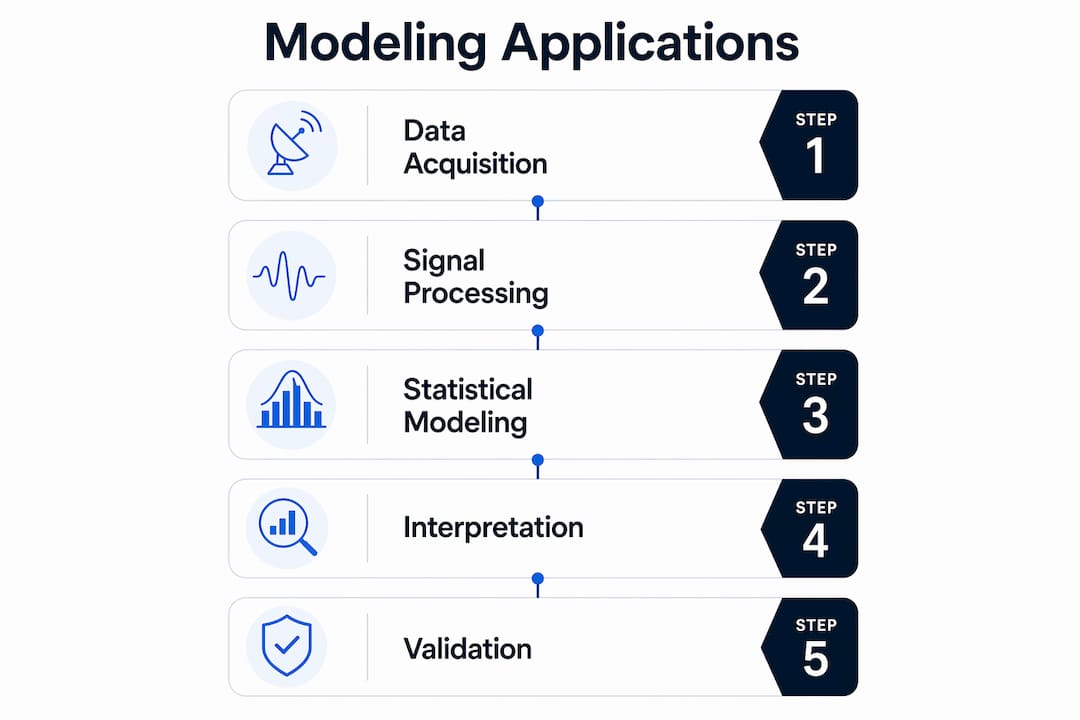
In forensic science, likelihood-based statistical models combined with simulated training data improve reproducibility and validation of DNA mixture interpretation. Simulated profiles incorporate peak height variability, degradation effects, and stutter artifacts to train algorithms before they encounter real casework samples. This simulation-first approach reduces the risk of overfitting to laboratory-specific conditions.
Key practices that define defensible forensic mixture modeling include:
- Explicitly stating the assumed number of contributors before computing likelihood ratios.
- Training algorithms on simulated known mixtures that reflect realistic peak height distributions and degradation patterns.
- Validating model performance against independently verified reference samples before casework application.
- Documenting all assumption declarations to support reproducibility during legal review.
In pharmaceutical analysis, high-resolution mass spectrometry (HRMS) coupled with data-independent acquisition enables simultaneous detection of trace impurities without derivatization. Statistical modeling then quantifies those impurities within complex chemical matrices, improving accuracy and reproducibility of impurity profiling. R2nsoftware’s PeakLab™ directly addresses this workflow by applying advanced mathematical algorithms to resolve overlapping chromatographic peaks, supporting impurity quantification in pharmaceutical-grade data.
Pro Tip: In pharmaceutical impurity profiling, always pair HRMS detection with a baseline correction model. Unmodeled baseline drift inflates impurity peak areas and produces false quantification errors that propagate through regulatory submissions.
The integration of experimental design, detection technology, and statistical modeling is not sequential. It is concurrent. Data quality decisions made during sample collection directly constrain what any downstream model can achieve.
What are the challenges in modeling complex mixtures with real-world data?
Real-world mixture data rarely arrives clean, balanced, or well-characterized. The challenges are structural, not incidental, and they require deliberate methodological responses rather than post-hoc corrections.
The four most consequential challenges are:
- Spectral overlap and signal degradation. Overlapping signals from co-eluting compounds or multiple DNA contributors create ambiguity that no model resolves without explicit deconvolution assumptions. Methods like Voigt deconvolution address peak shape asymmetry, but they require accurate instrument response function characterization.
- Heterogeneous data quality. Samples collected across different instruments, laboratories, or time points introduce systematic variance that confounds mixture effect estimates. Batch correction and normalization must precede modeling, not follow it.
- High dimensionality relative to sample size. Environmental mixture studies often involve dozens of correlated exposures measured in hundreds of participants. BKMR and regularized regression methods handle this, but they require careful hyperparameter selection and cross-validation.
- Assumption misalignment. Applying WQS to a dataset where components act in opposing directions produces a biased mixture index. Explicit assumption declaration before analysis is the single most effective safeguard against this error.
“Data quality decisions made during sample collection and detection critically shape what statistical modeling can achieve in complex mixture analysis.”
The distinction between qualitative and quantitative modeling goals also matters. A qualitative goal asks which components drive the mixture effect. A quantitative goal asks by how much. BKMR answers the first question well. WQS answers the second more directly. Conflating these goals leads researchers to select methods that produce the right numbers for the wrong question.
Statistical modeling integrates regression, Bayesian inference, and machine learning approaches to handle high-dimensional data, but interpretability and predictive power exist in tension. Hierarchical models and random forests both appear in mixture analysis pipelines, but their outputs serve different audiences and different scientific purposes.
How are advanced statistical frameworks evolving for complex survey and multivariate mixture data?
Large-scale mixture studies increasingly draw from structured survey datasets: national health surveys, electronic health records, and government environmental monitoring programs. These datasets introduce clustering, stratification, and unequal sampling probabilities that standard regression ignores at inferential peril.
Pseudo maximum likelihood (PML) methods allow valid multivariate parametric inference in complex survey designs by incorporating sampling weights directly into the likelihood function. This matters because simple random sampling adjustments in complex multivariate data undermine inferential validity. PML corrects this without requiring full Bayesian specification.
The table below summarizes advanced frameworks and their primary applications.
| Framework | Core Capability | Example Application |
|---|---|---|
| Pseudo maximum likelihood (PML) | Survey-weighted multivariate inference | National health and nutrition surveys |
| Structural equation models (SEM) | Latent variable relationships | Medical readmission risk modeling |
| Latent class models (LCM) | Subgroup identification within mixtures | Exposure pattern clustering in cohort studies |
| Hierarchical Bayesian models | Multi-level data structures | Multi-site environmental monitoring |
Structural equation models extend mixture analysis by allowing researchers to model latent constructs, such as cumulative chemical burden, as mediators between exposure and health outcome. Latent class models identify subgroups within a study population that share similar mixture exposure profiles, enabling targeted inference rather than population-averaged estimates.
Statistical modeling bridges descriptive data summaries and predictive machine learning by focusing on interpretability, hypothesis testing, and communication to non-technical stakeholders. This bridging function is especially valuable in governmental and medical data science contexts, where model outputs inform policy decisions and must be explainable to non-statisticians. Visualizations of posterior distributions, component weight rankings, and exposure-response surfaces translate complex model outputs into formats that support evidence-based decisions.
Key Takeaways
Statistical modeling for complex mixtures requires method selection grounded in study design, explicit assumption declaration, and data quality control before any model is applied.
| Point | Details |
|---|---|
| Method selection is decisive | Match WQS, BKMR, qgcomp, or PML to your study design and scientific question before analysis begins. |
| Simulation validates algorithms | Train forensic and pharmaceutical models on simulated data before applying them to real-world samples. |
| Data quality precedes modeling | Spectral overlap, batch effects, and heterogeneous collection conditions must be addressed before fitting any mixture model. |
| Advanced frameworks handle survey complexity | PML and structural equation models correct for clustering and stratification in large, structured datasets. |
| Assumption transparency is non-negotiable | Explicitly stating contributor counts, directional hypotheses, and prior specifications makes results reproducible and defensible. |
Why model selection discipline matters more than method sophistication
After working across environmental epidemiology, forensic science, and pharmaceutical analysis datasets, I keep arriving at the same conclusion: the most common failure in mixture modeling is not choosing the wrong algorithm. It is choosing the right algorithm for the wrong reason.
Researchers reach for BKMR because it sounds sophisticated, or they default to WQS because a collaborator used it last year. Neither is a scientific justification. The question that should drive method selection is always: what does my study design actually allow me to infer? A cross-sectional dataset with 200 participants cannot support the nonlinear interaction surface that BKMR estimates. Fitting it anyway produces a visually compelling output that the data cannot actually support.
The second pattern I find consistently underappreciated is the role of assumption transparency. Explicitly stating model assumptions before analysis, not after, changes how you interpret results and how reviewers evaluate them. In forensic DNA work, declaring the assumed contributor count before computing a likelihood ratio is standard practice. In environmental mixture analysis, the equivalent discipline is rarely applied with the same rigor.
The field is moving toward better tooling and better frameworks. Statistical modeling now integrates visualizations that make complex findings accessible to non-technical stakeholders, which is genuinely useful. But no visualization corrects a misspecified model. The discipline of matching method to question, and documenting every assumption, remains the work that no software automates.
— Nadeem
R2nsoftware tools for complex mixture modeling workflows
Researchers working through the method selection and signal resolution challenges described here need software that matches the analytical complexity of their data.

R2nsoftware’s PeakLab™ applies advanced mathematical algorithms and statistical models to resolve overlapping signals in chromatographic and spectroscopic data, supporting up to 1,000 simultaneous peaks. For curve fitting across two-dimensional datasets, CurveFit 2D and TableCurve Studio provide the quantitative framework needed for impurity profiling and peak area quantification. R2nsoftware’s video tutorials walk through practical modeling workflows, from baseline correction to full mixture deconvolution, giving researchers the applied context to use these tools effectively on real datasets.
FAQ
What is the role of statistical modeling in complex mixtures?
Statistical modeling decomposes the combined effect of multiple compounds or contributors in a mixture, enabling researchers to quantify individual component contributions and detect interaction effects that simple regression cannot resolve.
Which statistical method is best for environmental mixture analysis?
No single method is universally best. WQS suits unidirectional cross-sectional designs, BKMR handles nonlinear interactions, and qgcomp offers flexible covariate adjustment. Method choice depends on study design and scientific goal.
How does simulation improve mixture model validation?
Simulated profiles that incorporate peak height variability, degradation, and stutter train algorithms under controlled conditions before real-world application, improving reproducibility and reducing overfitting to laboratory-specific artifacts.
Why do complex survey designs require specialized modeling methods?
Standard regression ignores clustering, stratification, and unequal sampling probabilities in survey data. Pseudo maximum likelihood methods incorporate sampling weights directly into the likelihood function, preserving inferential validity across structured datasets.
How does HRMS improve pharmaceutical impurity profiling?
High-resolution mass spectrometry enables simultaneous detection of trace impurities without derivatization. Paired with statistical modeling for quantification, it improves accuracy and reproducibility of impurity profiling in complex chemical matrices.